Later
Guitars
I think it was in 2018 that
I got an email from StewMac advertising a Strat style guitar
kit. It was on sale for $150 and I thought "Why not, I've
never played a Strat so it might be fun to throw this thing
together and see if I like it". That's how I got hooked on
building guitars again. The kit was mediocre at best. It turned out okay
but I quickly realized that I was not a Strat guy. I also
realized that I could make better guitars from scratch
than any kit I could buy. I put together a few Strat and
Tele style partscasters using ready made necks and bodies.
Then I started making my own bodies and using ready made
necks. I finally realized I could make just as good (if
not better) necks myself. That, of course, got me into
buying tools (it’s yet another addiction). The guitars
don't start getting interesting for a while. The first
bunch are kits or partscasters.
So, without further ado, here are the guitars (and one bass) that I built so far. First, the StewMac kit Strat.
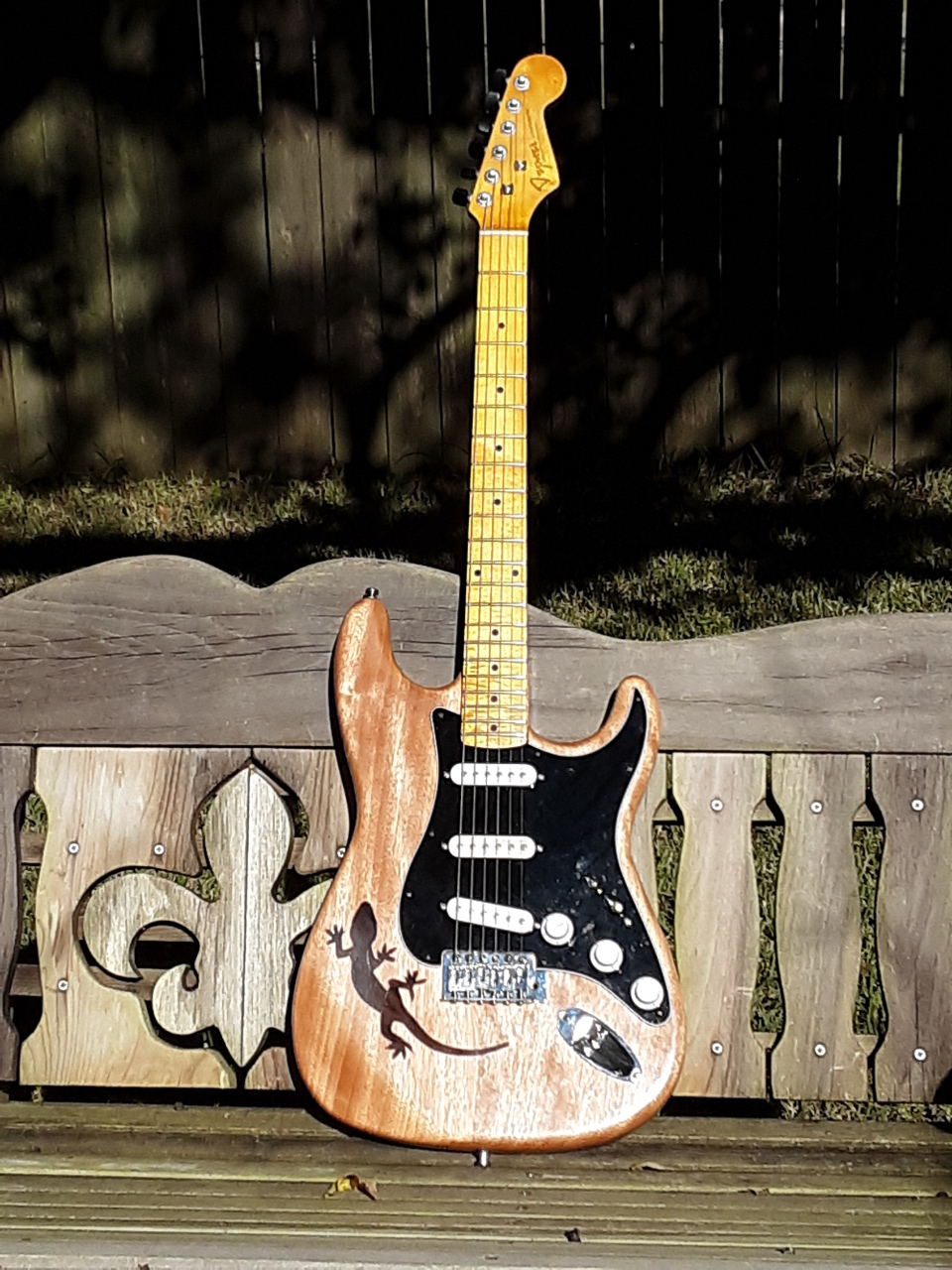
So, without further ado, here are the guitars (and one bass) that I built so far. First, the StewMac kit Strat.
×
![]()
I replaced the tuners with
some Schaller lockers I had laying around and I inlaid a
gecko made of ziricote just to give it some flash.
Next, I put together a kit Tele for my friend Phil. The kit was from Guitar Fetish (GFS) and it was better made than the StewMac kit (I just call 'em like I see 'em).
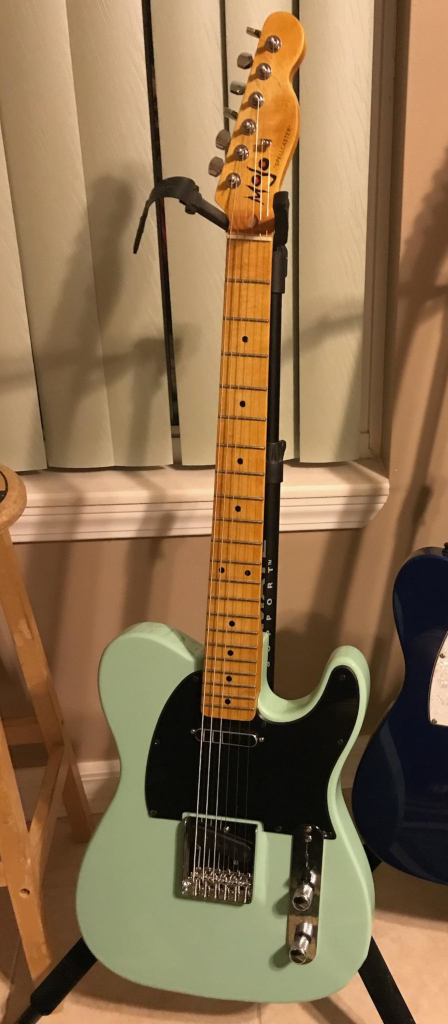
Next, I put together a kit Tele for my friend Phil. The kit was from Guitar Fetish (GFS) and it was better made than the StewMac kit (I just call 'em like I see 'em).
×
![]()
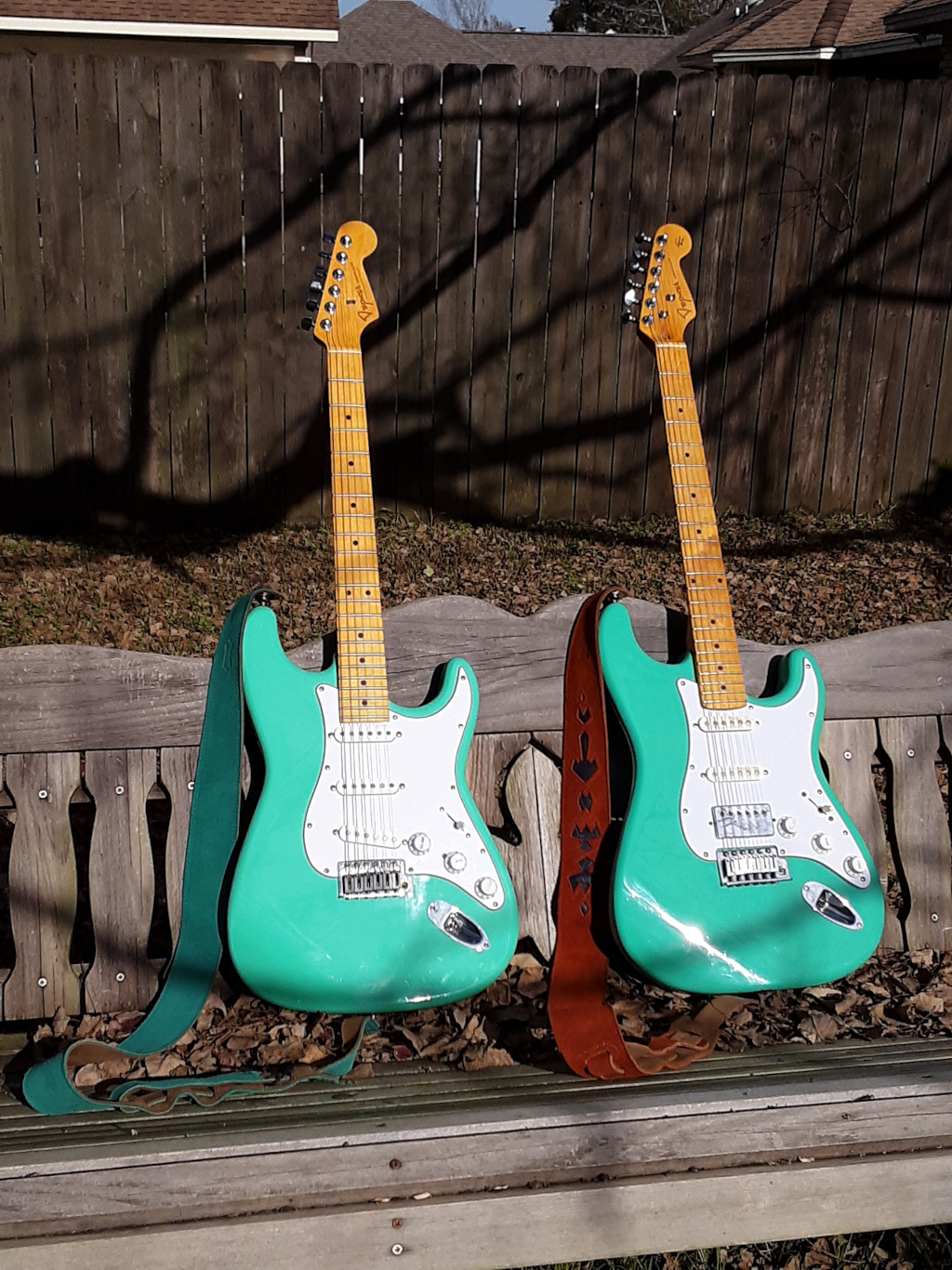
I then made a pair of
seafoam green GFS partscasters, both Strats. One SSS,
and the other HSS.
×
![]()
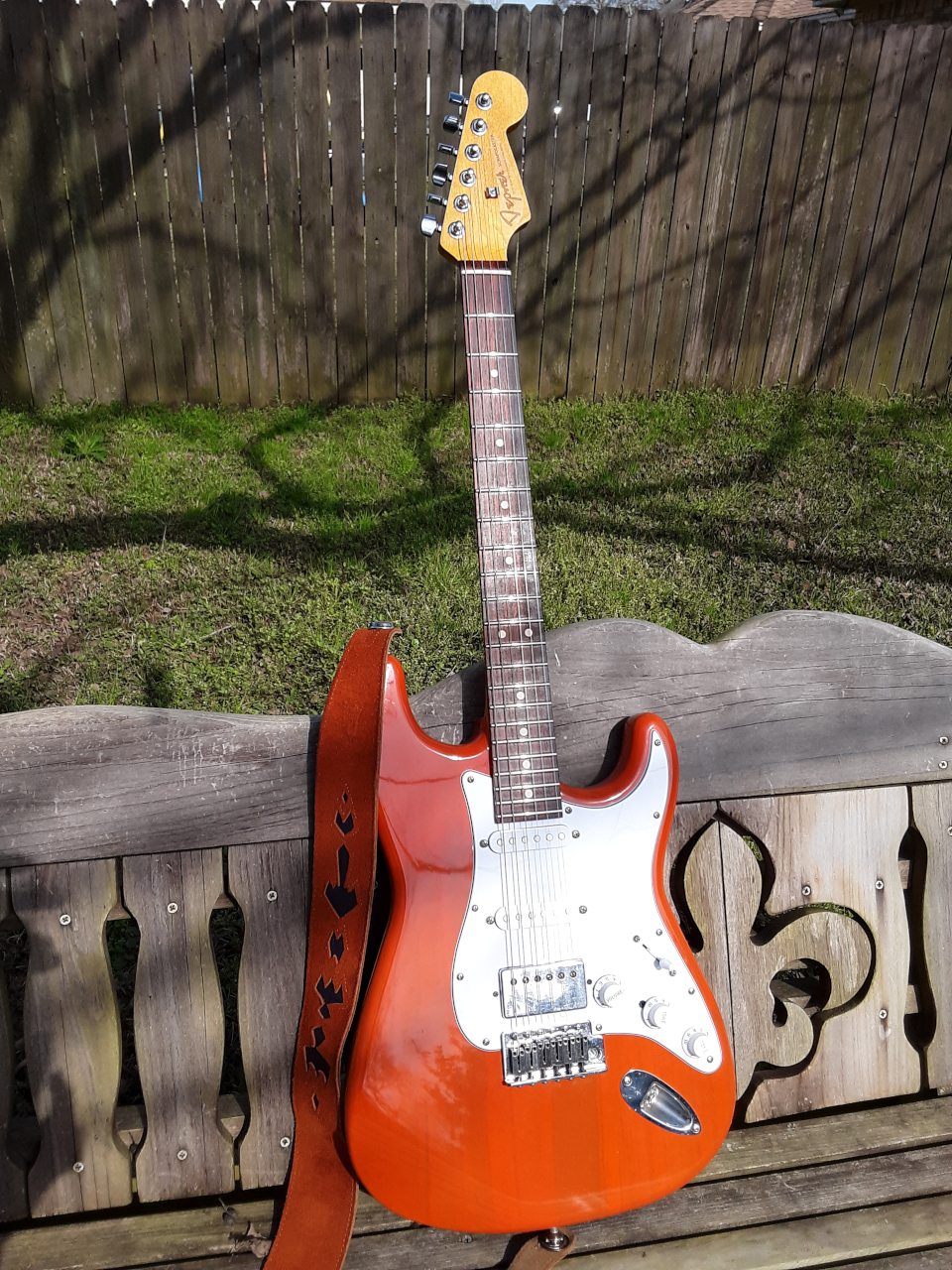
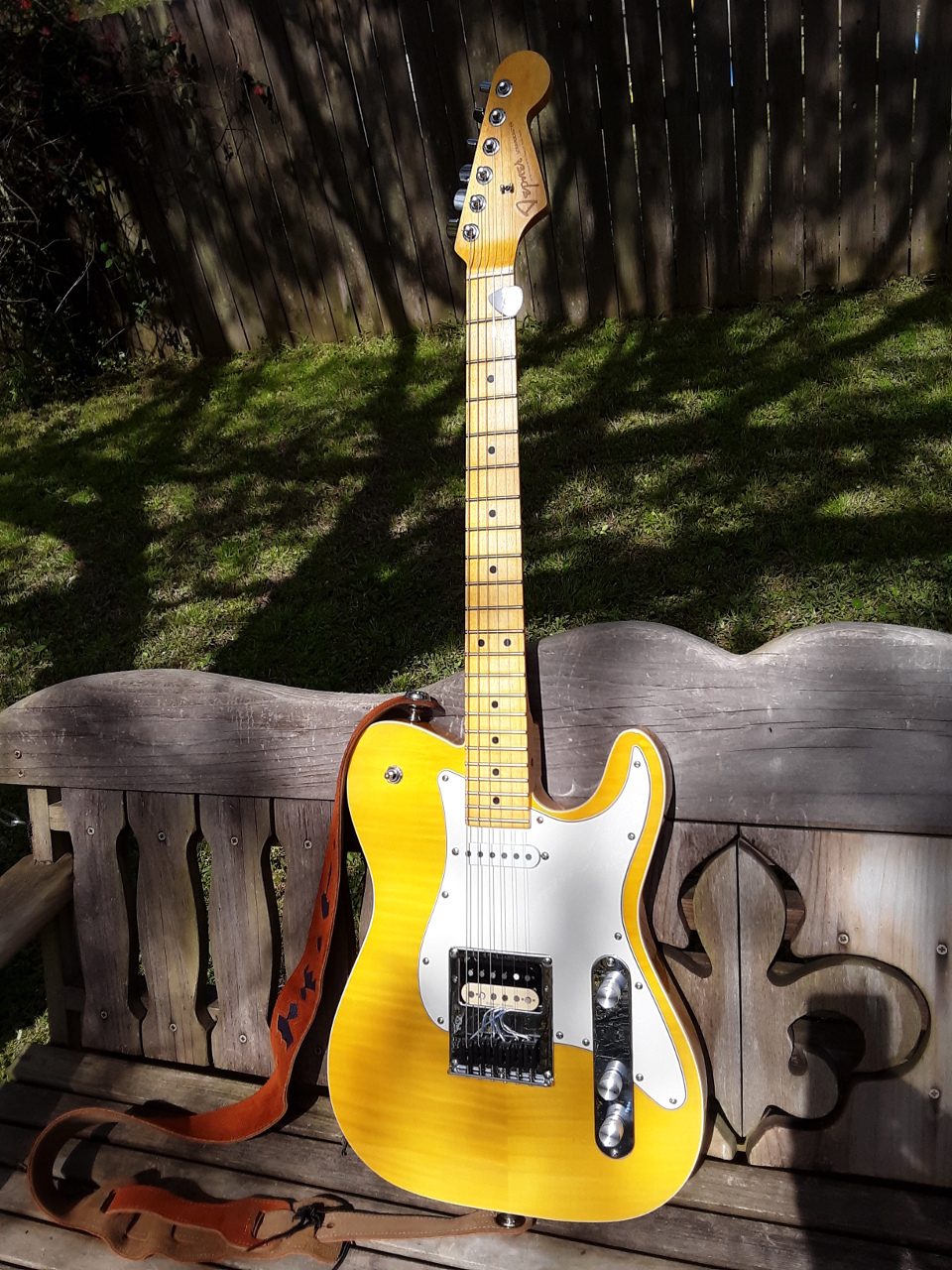
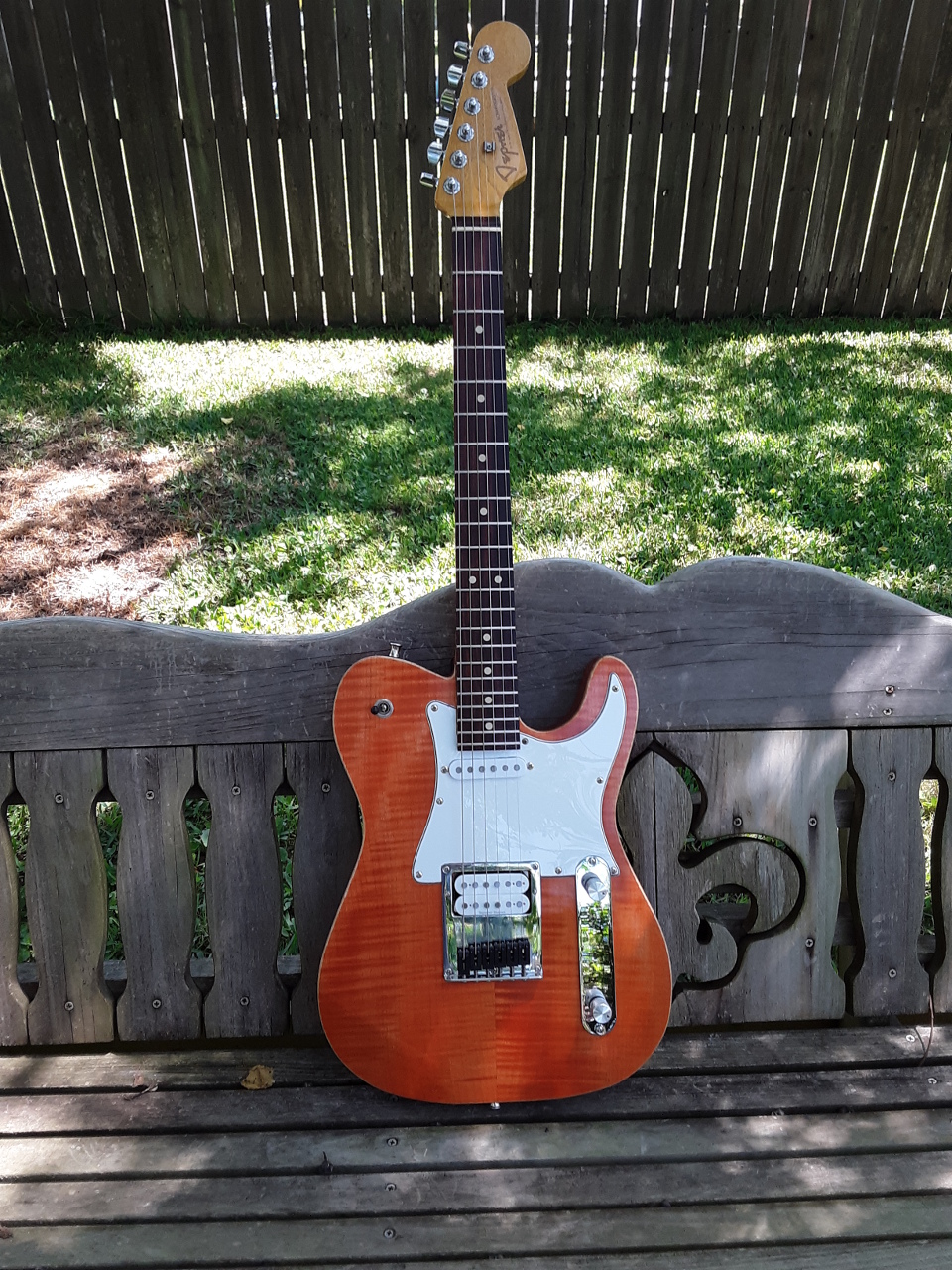
Next I made a handful of partscasters using GFS bodies and necks.
×
![]()
×
![]()
×
![]()
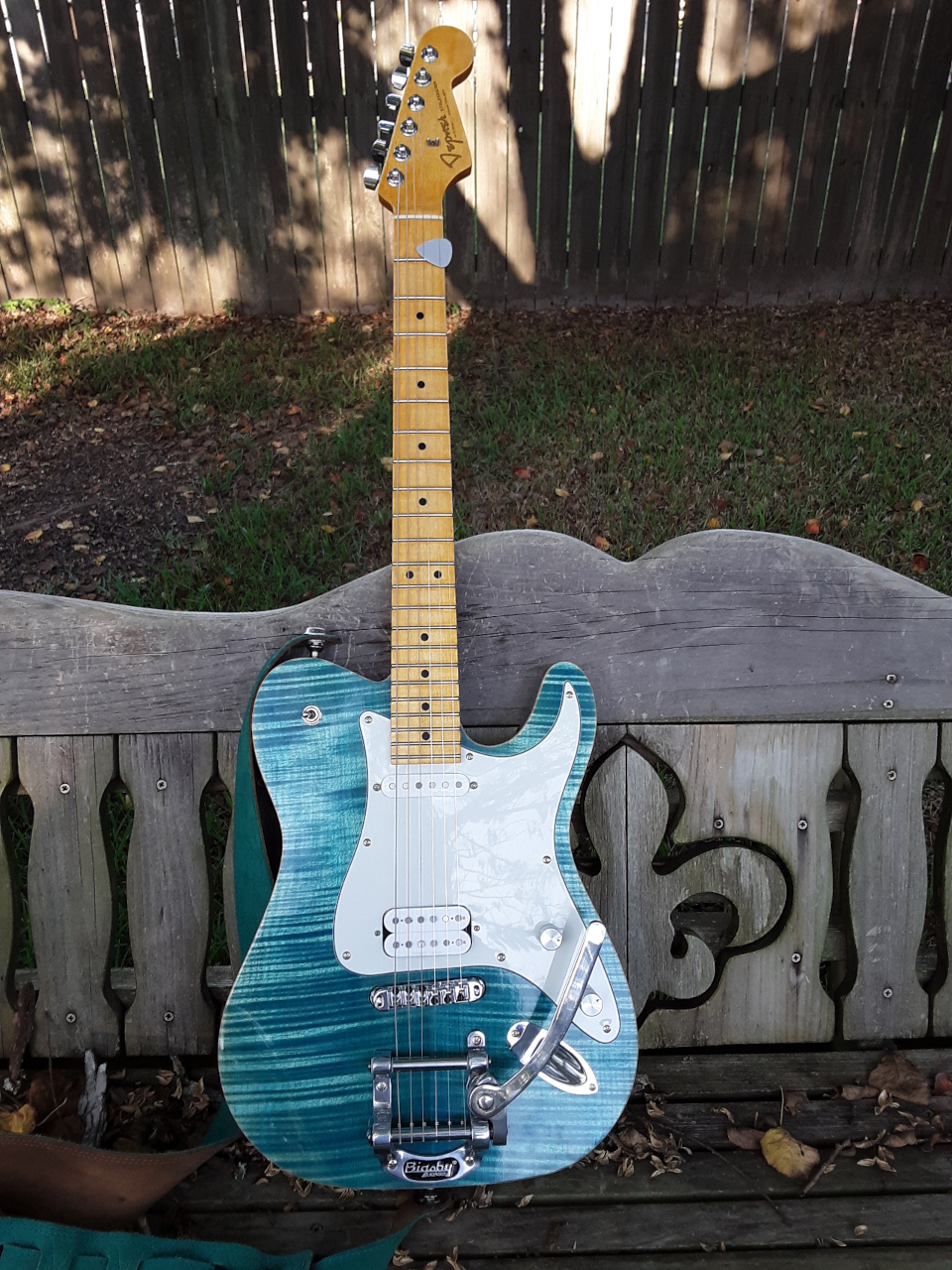
Somehow I got the idea that I wanted a guitar with a Bigsby whammy bar. This was my first complete body build. I used a basswood blank and a Northridge Hardwoods flame maple drop top. Instead of angling the neck I recessed the Tune-O-Matic style bridge. I quickly discovered that I'm not a fan of Bigsby whammy bars (or any whammy bars for that matter).
×
![]()
It's also a bad idea to use a Strat style jack on a guitar with a Bigsby whammy bar as you can see by the above image.
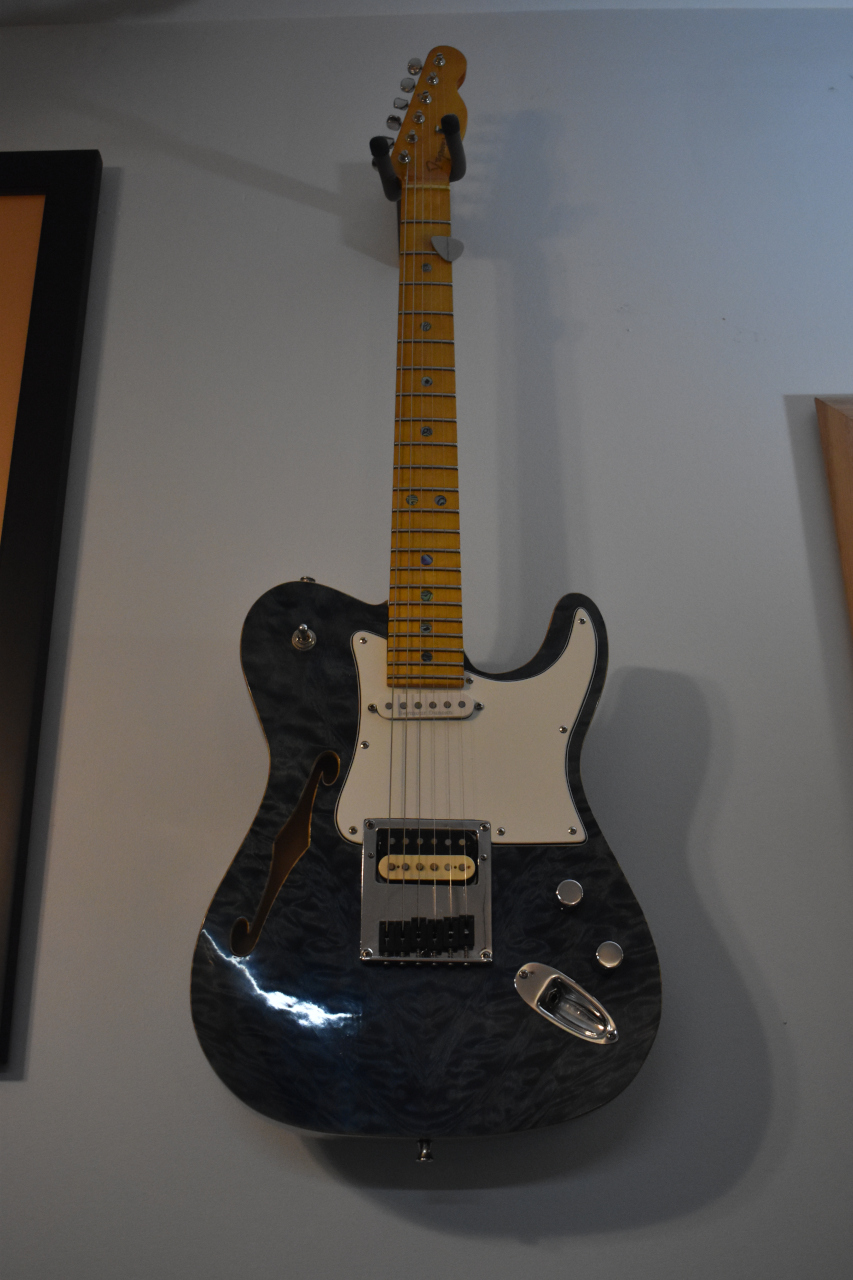
To correct the problems with the Strat jack and the Bigsby I built a more standard Tele style guitar. I used basswood and a quilted maple drop top from Northridge Hardwoods. I tried to use what I, at the time, considered the best features of the Strat, Tele, and various Carvin/Kiesel guitars. Thus, it became the STeleKaster.
×
![]()
This was my first time
doing what PRS guitars call a faux binding. That is,
I stained the top, back, and sides but masked off
the edge of the drop top and left it natural. I did
the same for the f-hole (which I cut before I glued
on the drop top).
The problem here is that building guitars becomes an addiction. So, I continued building guitars just because. I had found that I didn't like the Strat style jack. Especially if I wanted to use a 90 degree plug or a wireless. I moved the jack to the side of the guitar like a standard Tele but I addressed the big problem with the Tele jack - it's too far south on the body. If you put a Tele on a normal guitar stand, the plug gets in the way. To fix that I just moved the jack a bit farther north. This was my first time trying a "burst" finish using water-based stains (Transfast and/or Colortone, I forget which this was).
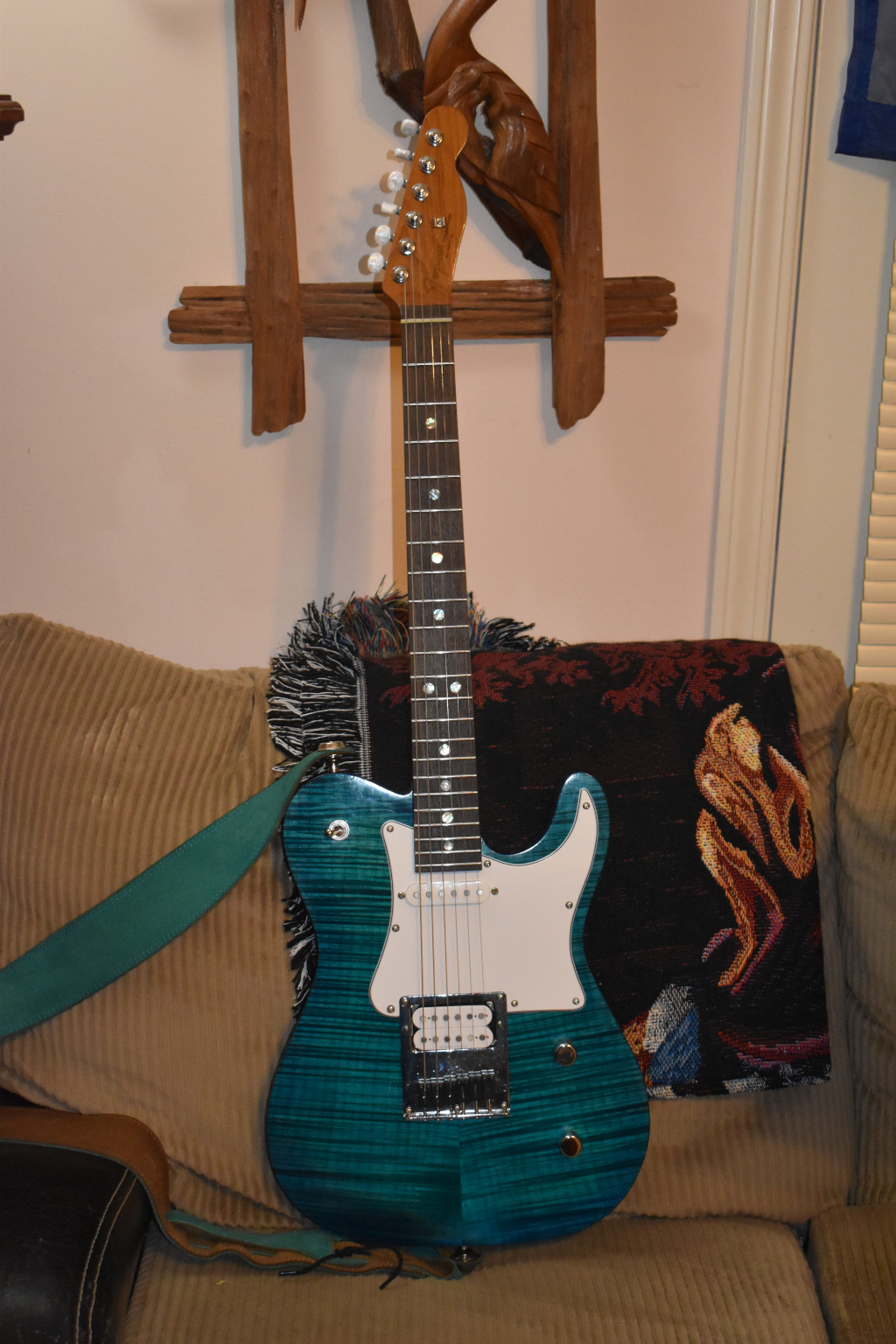
The problem here is that building guitars becomes an addiction. So, I continued building guitars just because. I had found that I didn't like the Strat style jack. Especially if I wanted to use a 90 degree plug or a wireless. I moved the jack to the side of the guitar like a standard Tele but I addressed the big problem with the Tele jack - it's too far south on the body. If you put a Tele on a normal guitar stand, the plug gets in the way. To fix that I just moved the jack a bit farther north. This was my first time trying a "burst" finish using water-based stains (Transfast and/or Colortone, I forget which this was).
×
![]()
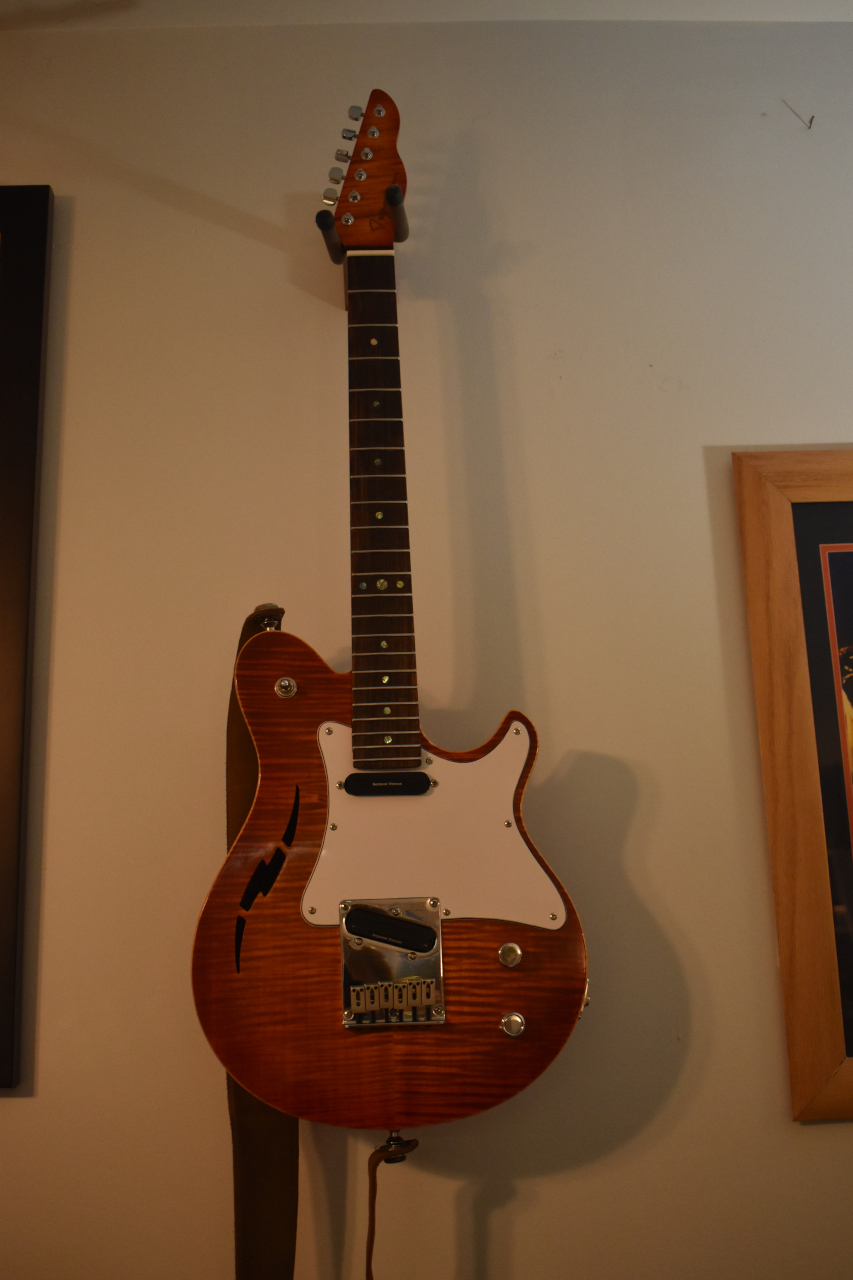
I was having some problems with my back about that time so I thought I'd try a different body shape. It turns out that the MusicMan Axis guitar body is 13% smaller than a Telecaster body. I figured I'd give that a try but hollow it out like the Tele style bodies and add an f-hole. This was also the point at which I started making my own necks. I can build a neck for around $80 as opposed to Warmoth who charged upwards of $200 for plain maple and rosewood unfinished neck with no dot markers or side dots. If you want to see how I build a neck check out Building a neck in the menu on the left.
×
![]()
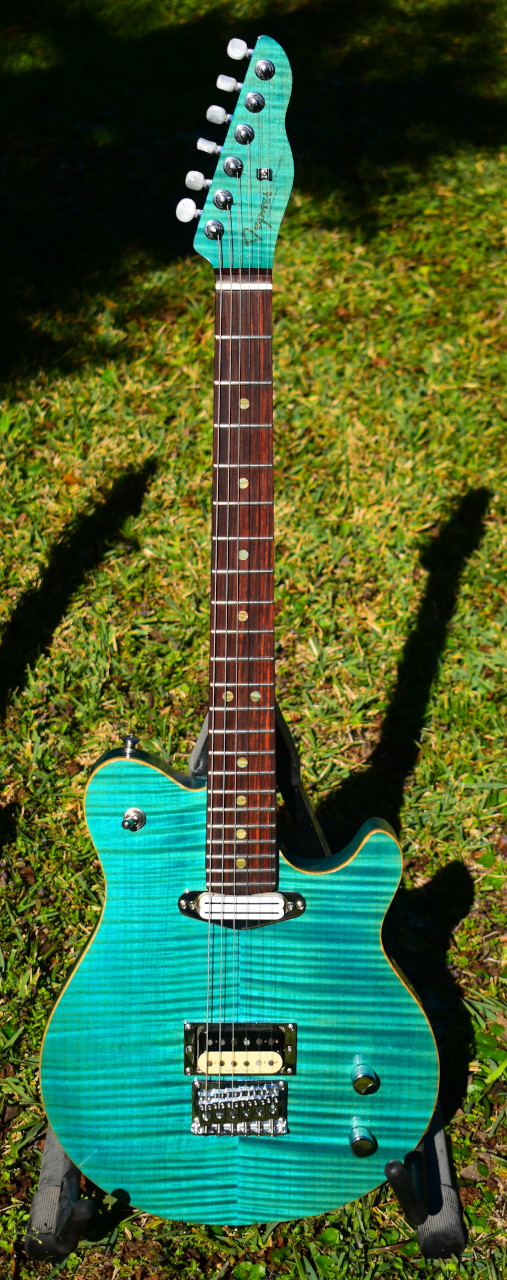
One thing I discovered on making and playing the Axis style bodied guitar was that the upper bout was too far north. The guitar hung more like a Strat. That is, when playing it I was looking down on the 9th or 10th fret. When playing a Tele you are looking straight down on the 12th fret (approximately). This was one of the reasons why I didn't like the Strat body (although it took me a while to put my finger on it). To help alleviate that problem I removed about 3/4" from the upper bout.
×
![]()
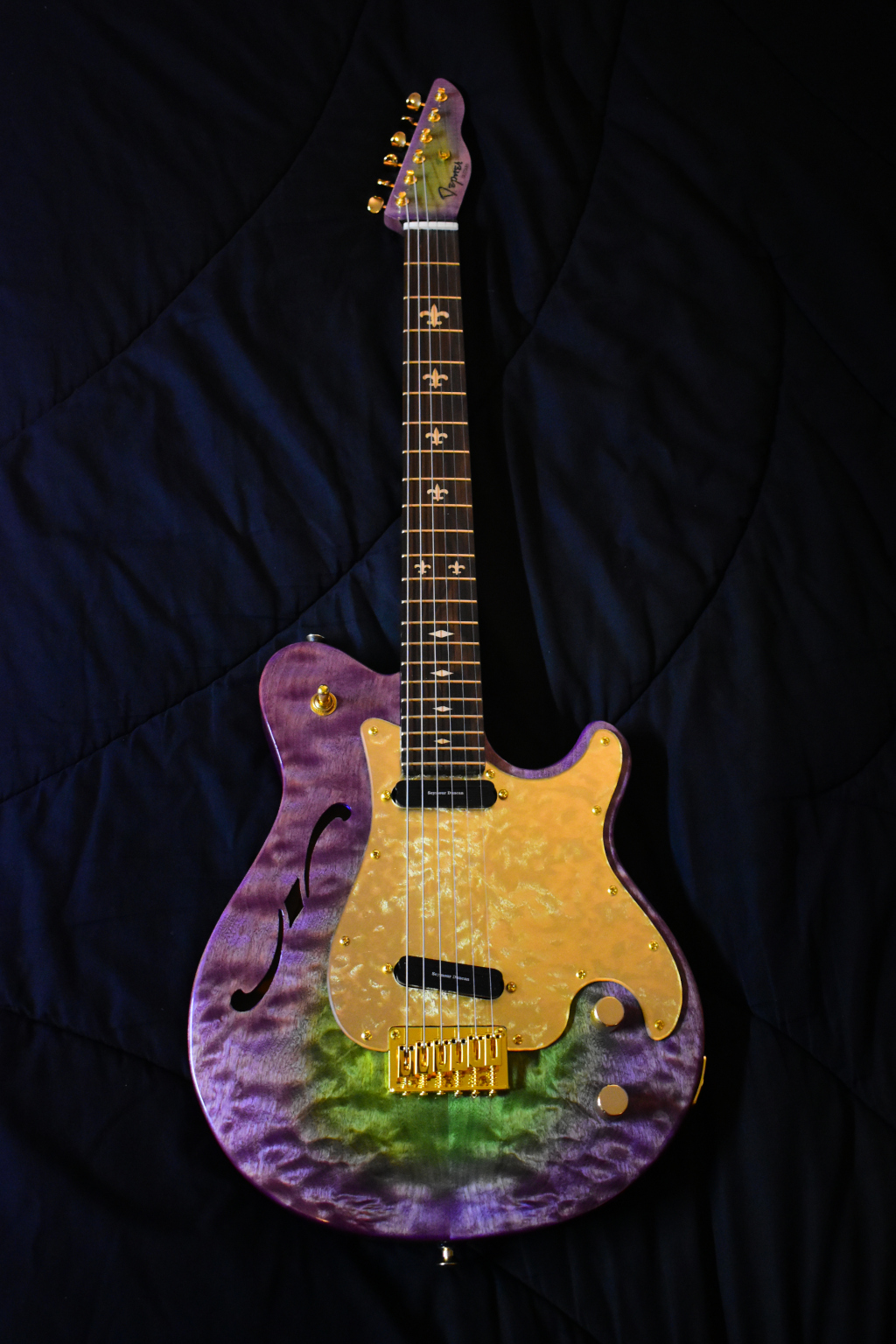
Since my band was playing a bunch of Mardi Gras balls at that time I decided to build a Mardi Gras themed guitar. I couldn't find a decent gold pickguard until I found Quick Guards. The one I chose was a gold Florentine design (made with 22 karat gold leaf). It was expensive but the outcome made it worth it.
×
![]()
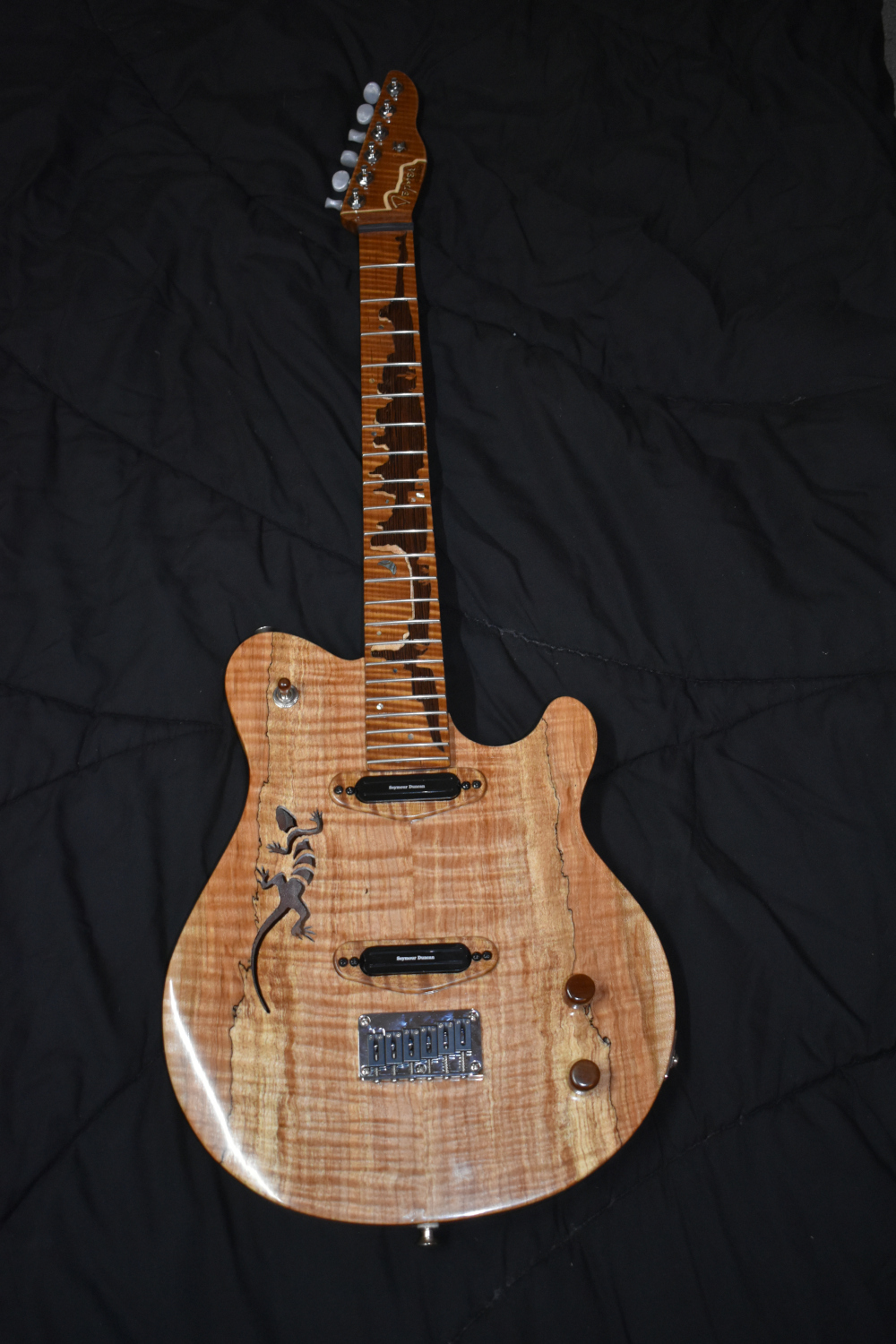
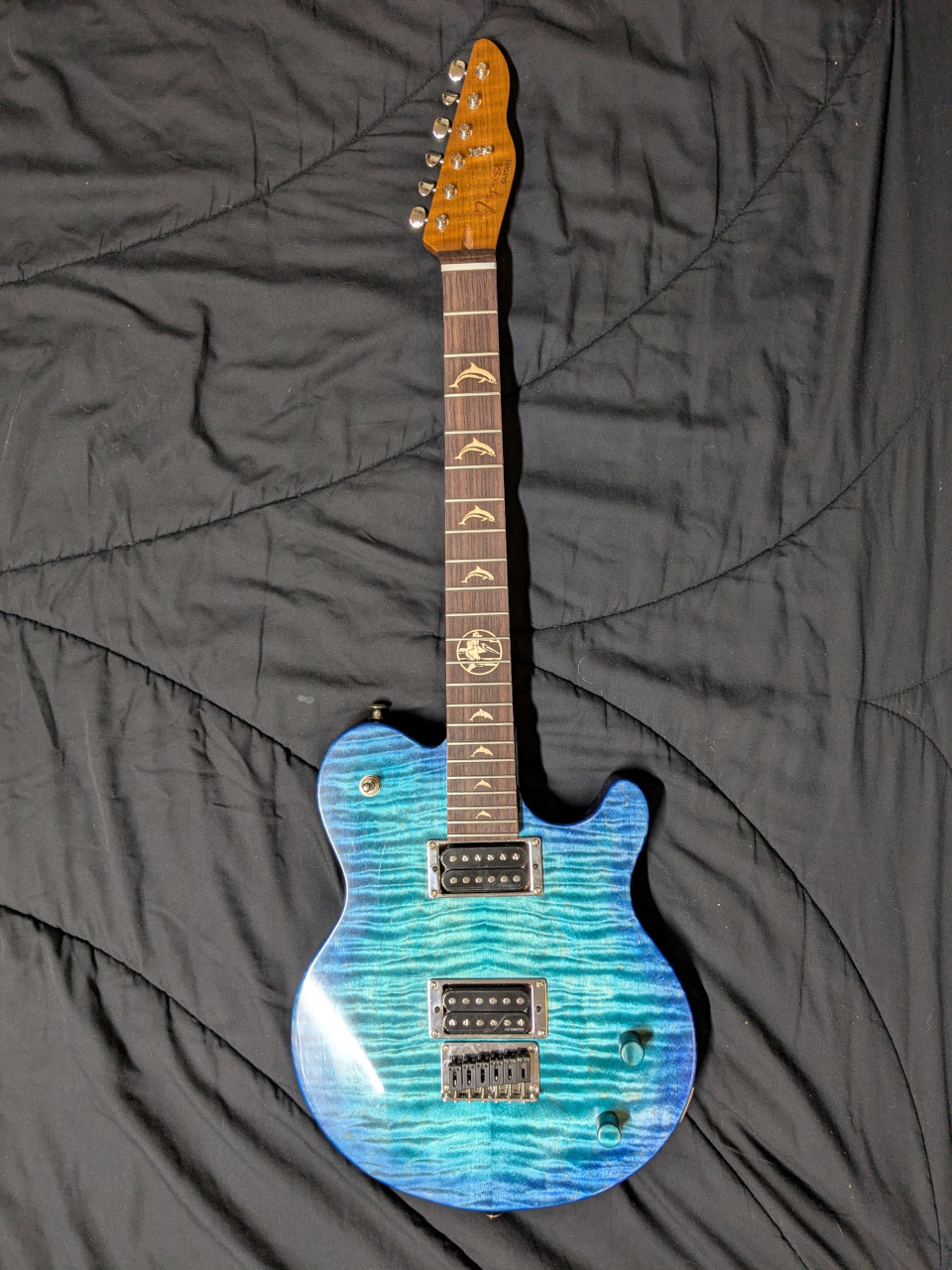
At this point I started getting into making themed guitars. This time I thought it would be cool to make a southwest themed guitar. Being incredibly clever I decided that I wanted to make a neck with a "cool" scene running down the fingerboard. I came up with a desert skyline at night. This guitar was made of basswood and heavily spalted flame maple. I tried to cut the western collared lizard f-hole using my Sculpfun S10 laser but the wood was so punky that it immediately burned like a fireworks punk. I ended up drawing it on and cutting it out using a scroll saw. The neck and fingerboard are both roasted flame maple. When I bought the neck and fingerboard blanks from American Specialty Hardwoods they cut them from the same piece of wood. When I glued them together it looked like one single piece of wood (that never happened again but it was pretty cool).
×
![]()
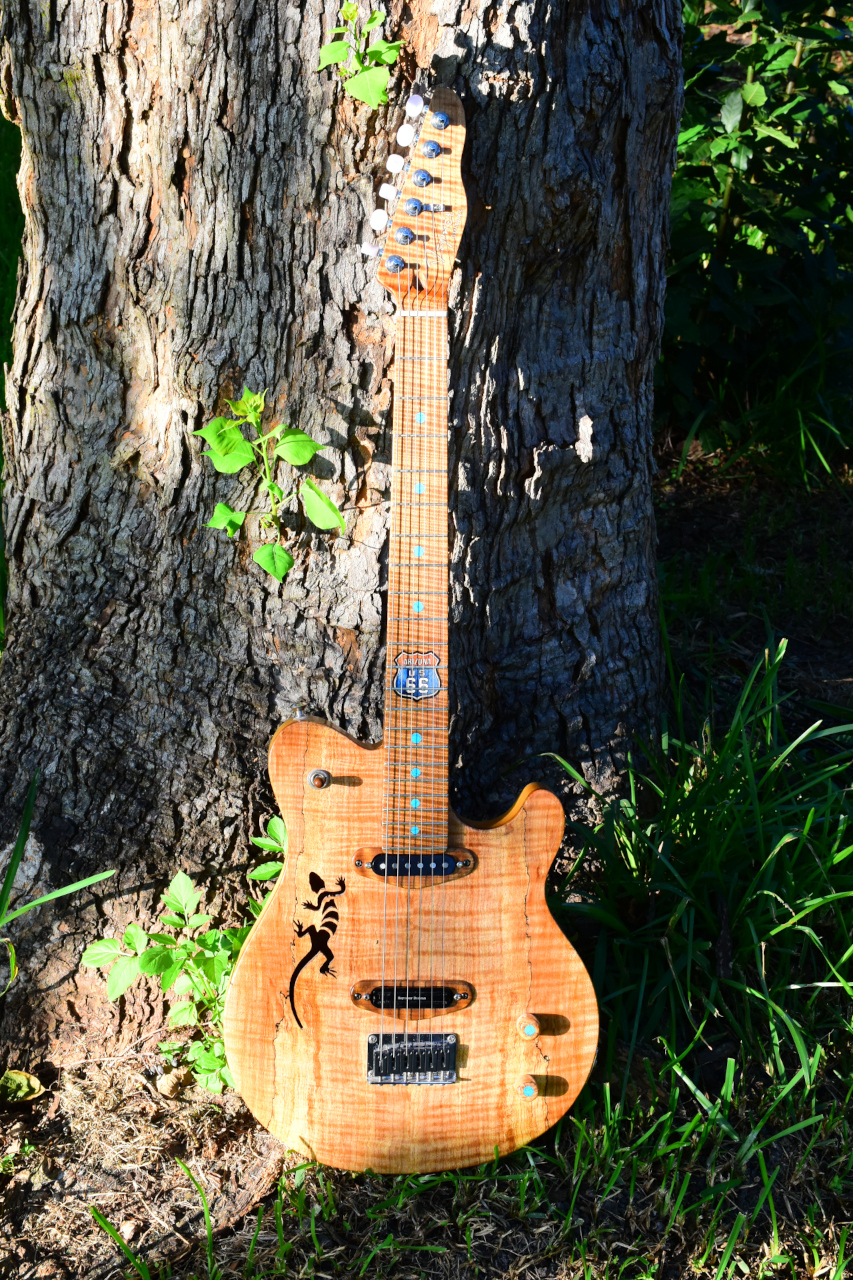
This is the lightest guitar I've ever made. Completely finished with all hardware installed it weighed 4 pounds and 4 ounces. It was like playing air guitar. I still have it and play it whenever my back starts hurting. Isn't that neck cool!? Yeah, not so much. When it came to playing it I had a heck of a time figuring what fret I was on when playing above the 12th fret. My advice - never buy or build a guitar with a full length inlay. It gets really confusing. I finally made a new neck and new knobs to fix that problem. I actually think it looks better now.
×
![]()
The inlay at the 12th fret is made of rosewood, bloodwood, aspen, and dyed birch (blue). The dot markers and the dots on the knobs are turquoise.
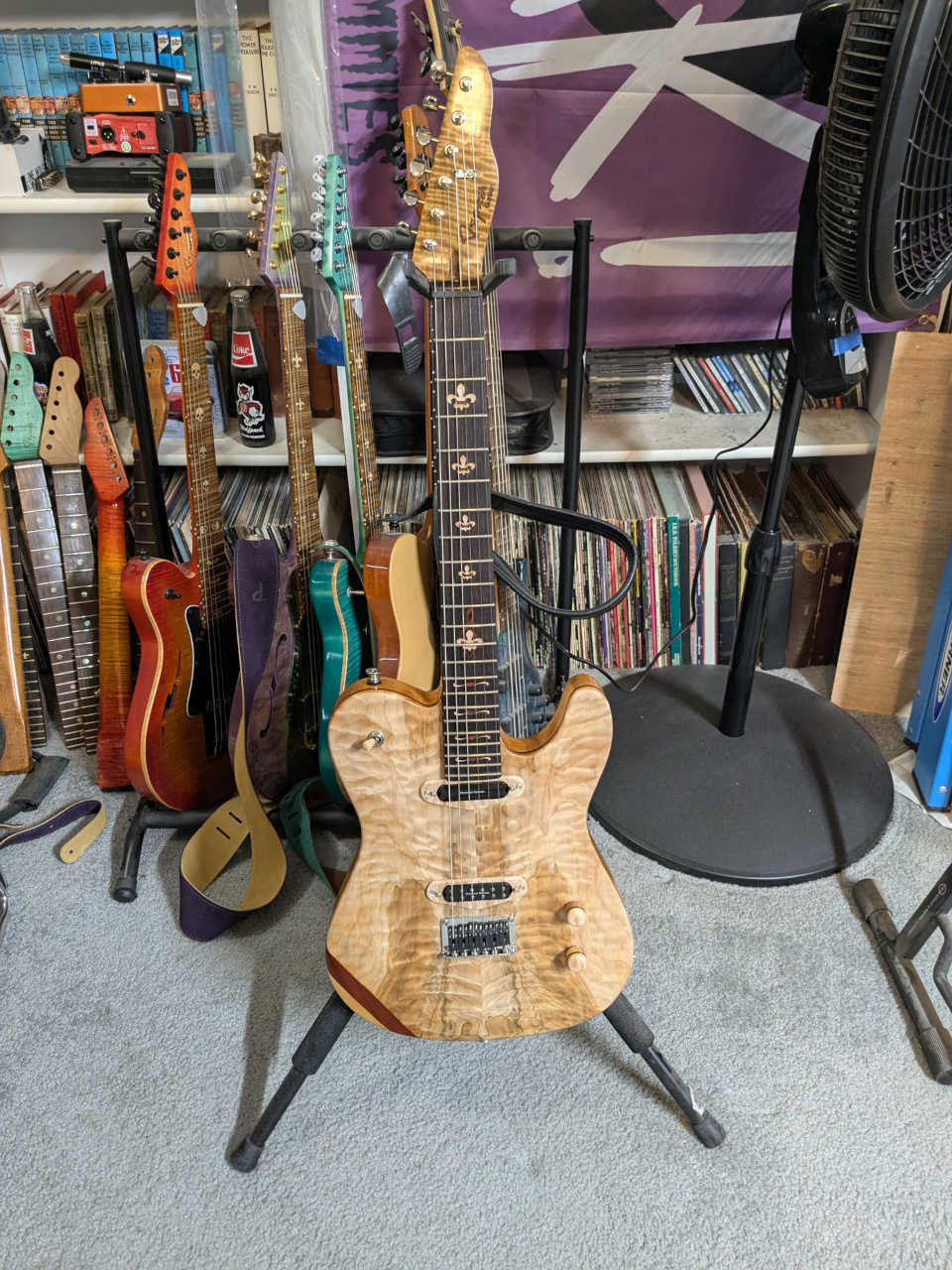
I was working on a Tele for a friend and I found that I missed the "feel" of the Tele style body. It's always been my favorite in terms of how it hangs when playing. So, I got nostalgic and made a standard Tele style guitar. This one is made from basswood (of course) and spalted, colored, quilted maple from Kimball's Hardwoods. Because the top was very thin I decided to add a middle layer of padauk (I won't do that again - it turns everything orange and then fades to brown anyway). Note the padauk used in the fingerboard - it's now almost invisible in contrast to the rosewood board. This was my first CA glue finish. All of the previous guitars were finished with TruOil or water-based poly. CA is soooooooo much better.
×
![]()
In addition to back problems I also have bad arthritis in my left (fretting) hand. I can only bend or straighten my middle finger on that hand. Because of that I have to play more classical style. That is, arm completely under the neck. I found that, when I moved above the 12th fret I kept banging in to the horn. To fix that I designed a short horn guitar body.
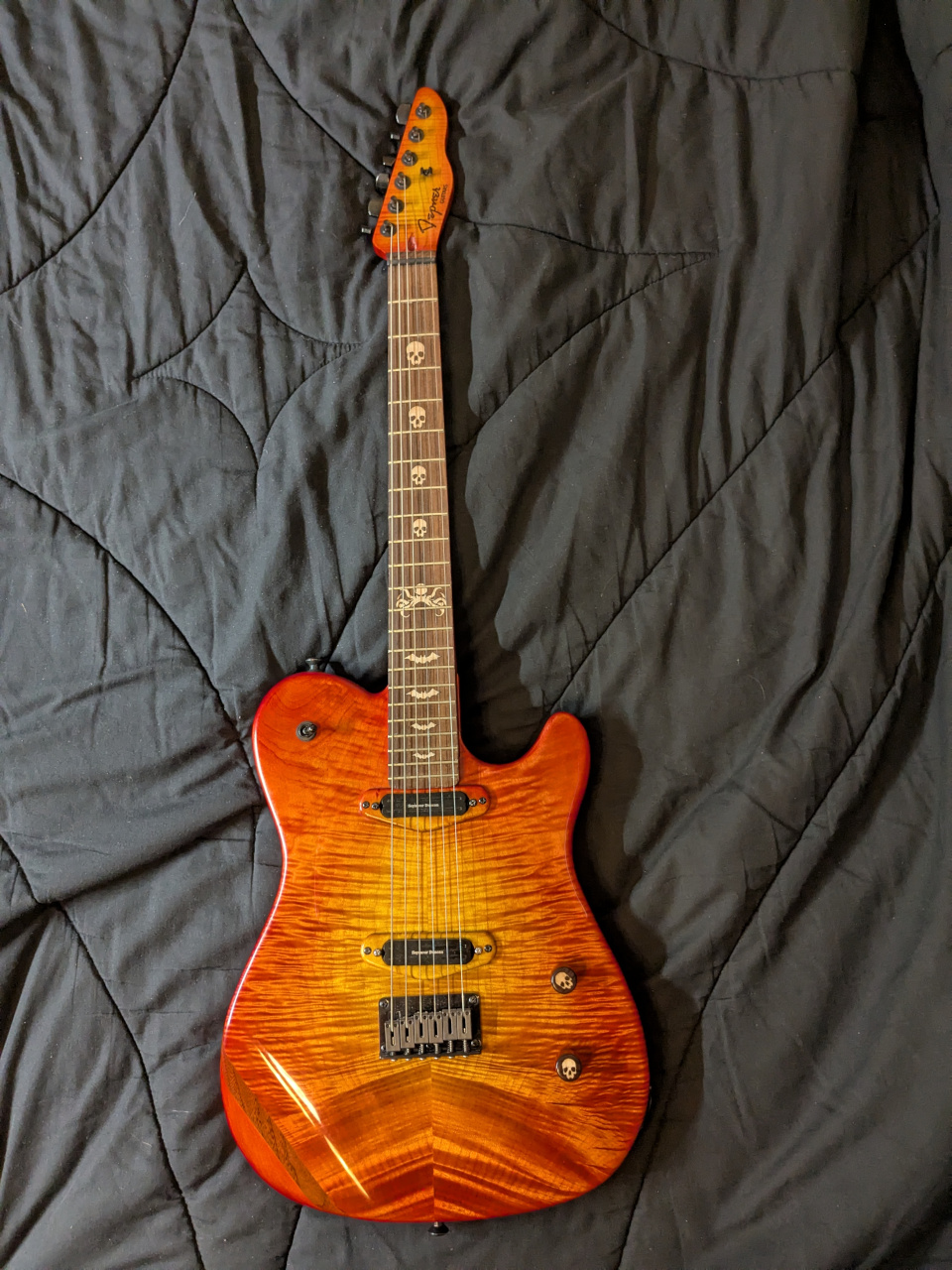
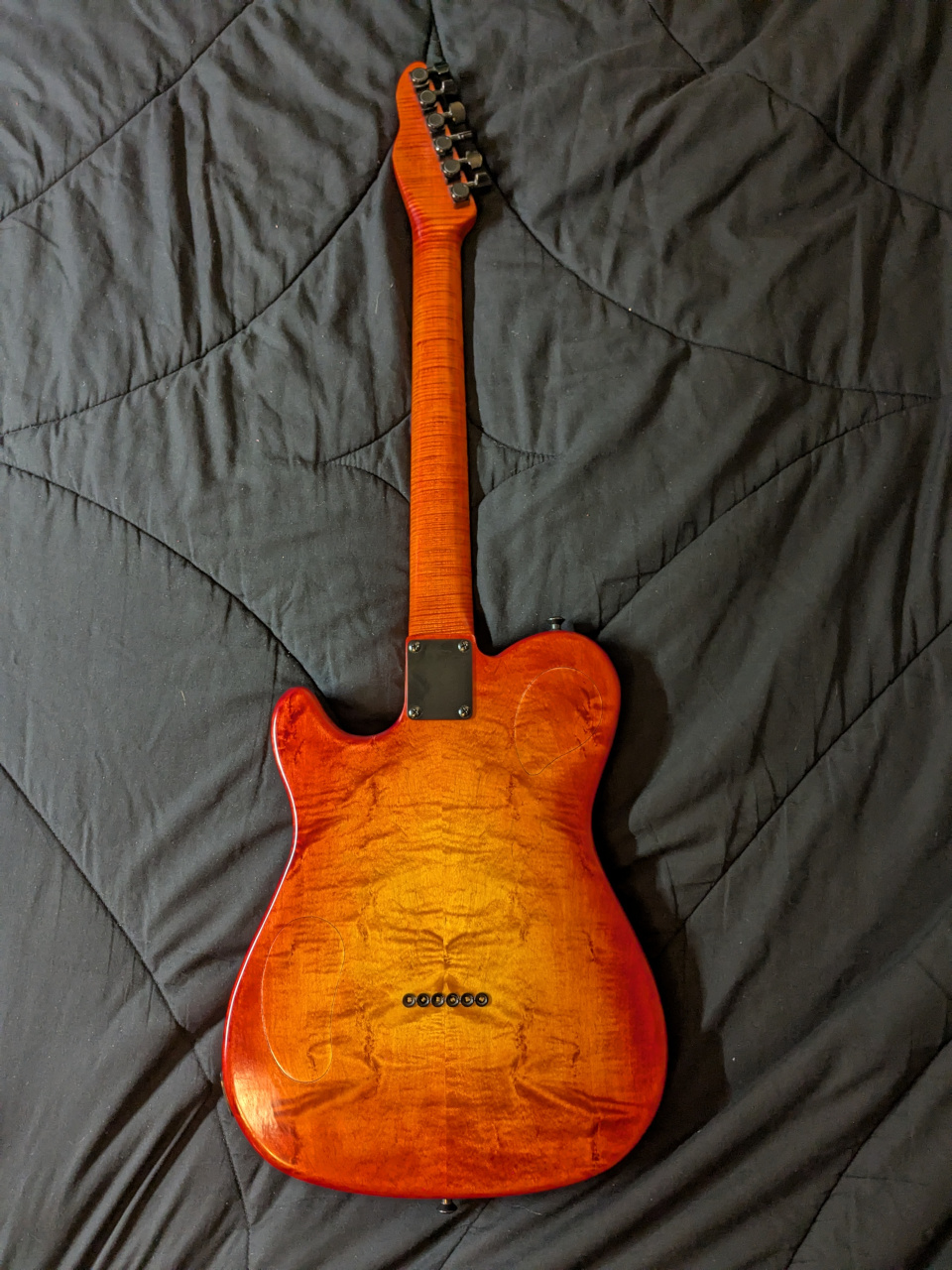
Continuing on with the themed guitars, I decided I needed a Halloween guitar. This time, instead of routing out the inside of the guitar I figured I could just cut it out and then have a drop top and a drop back. The top is big leaf flame maple from and the back is red leaf quilted/flame maple (both from Kimball Hardwoods). The neck is flame maple.
×
![]()
×
![]()
The "drop back" was probably a bad idea. Although it's beautiful this is one of my heavier guitars - around 6 pounds.
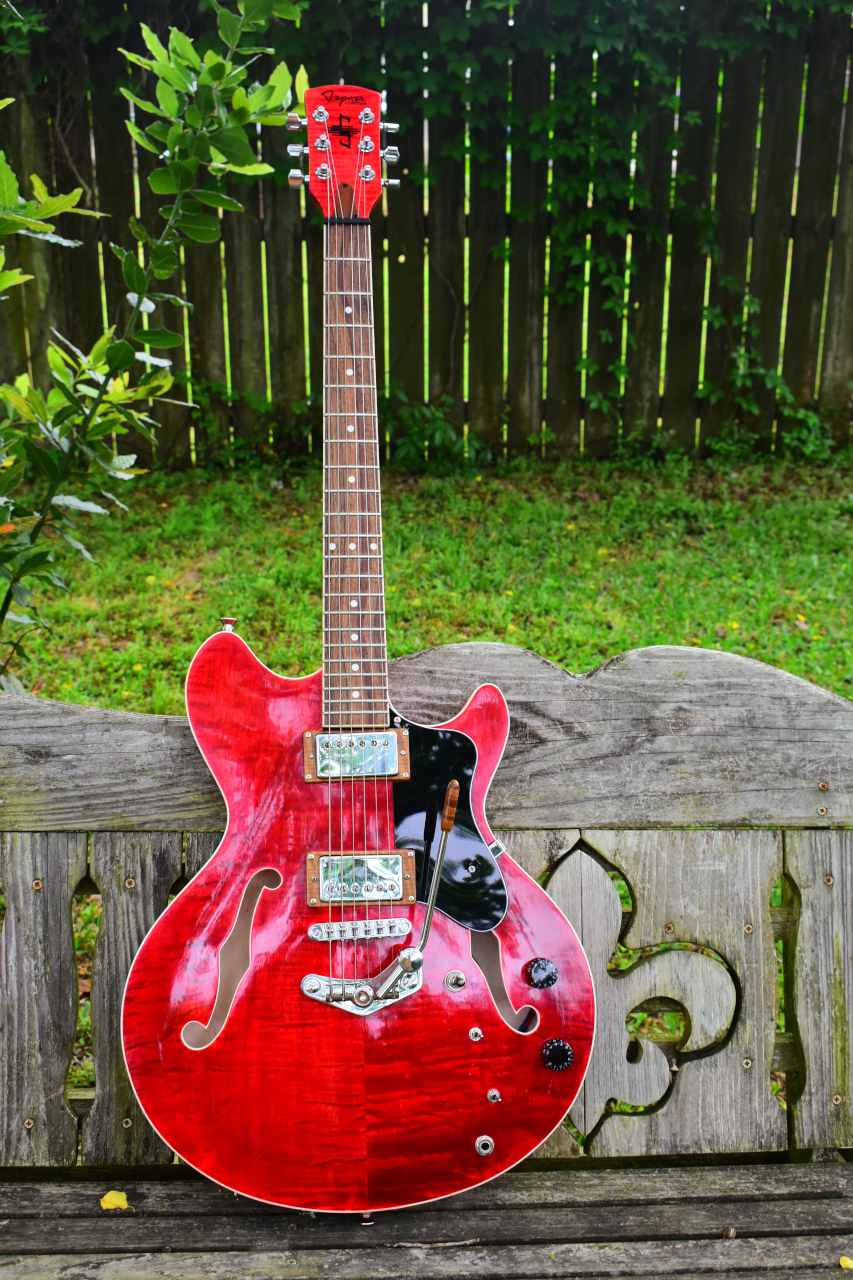
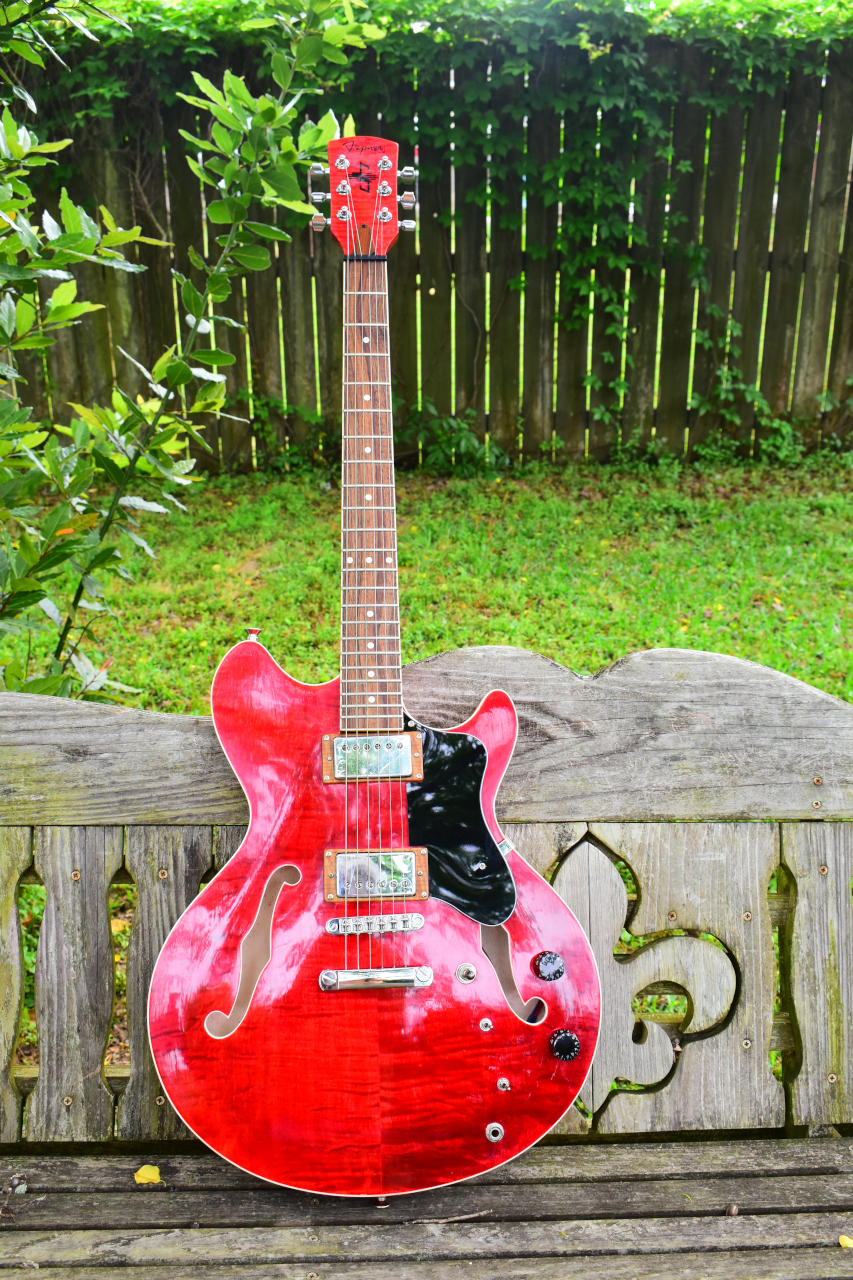
I had been buying tools and parts from Solo Guitars for quite a while and, for some unknown reason, I thought it might be fun to build one of their archtop kits. What I really liked about this kit was that it was very ES335-ish but with asymmetrical horns. Really cool looking. I changed the wiring to have just a single volume and tone and a couple of series/parallel switches. The Guyker whammy bar was far too long so I cut it off and made a roasted flame maple knob for it. I also had both whammy and non-whammy tail pieces for it.
×
![]()
×
![]()
A friend of mine bought this one for cost plus $100 (about $500).
Once again, in quest of a lighter guitar, I needed a new design. In this case I combined the Tele upper bout with the Axis lower body and horn. Not too bad but it still didn't feel like a Tele.
×
![]()
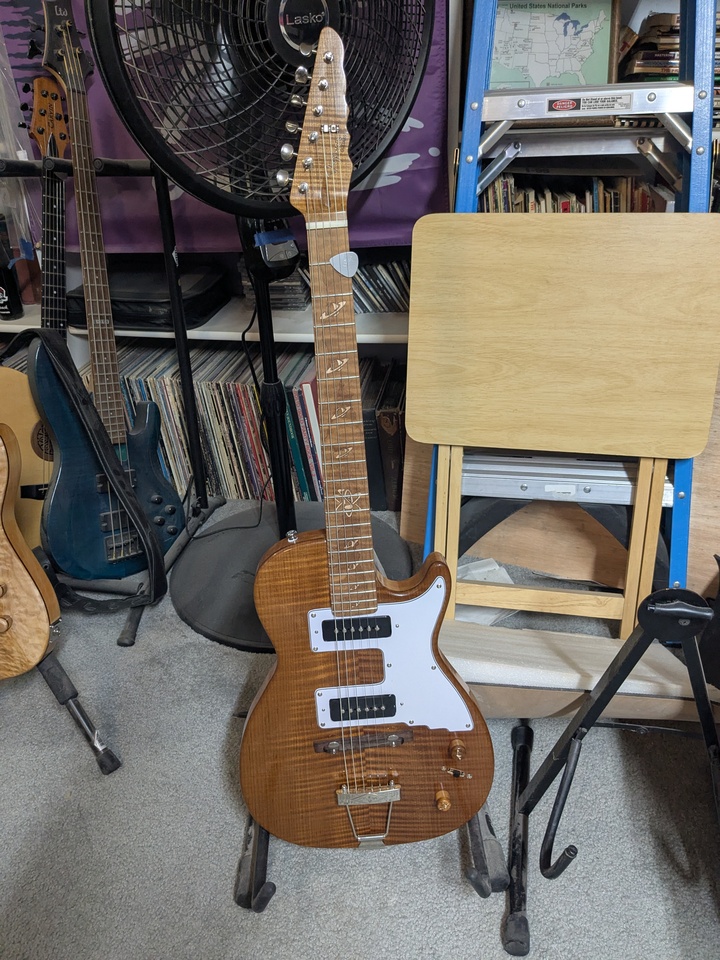
A friend of mine wanted me to make him a sort of copy of a late 50's Harmony Stratotone guitar. Weird, huh? Anyway, he wanted a 24" scale neck and P90s (among other things).
×
![]()
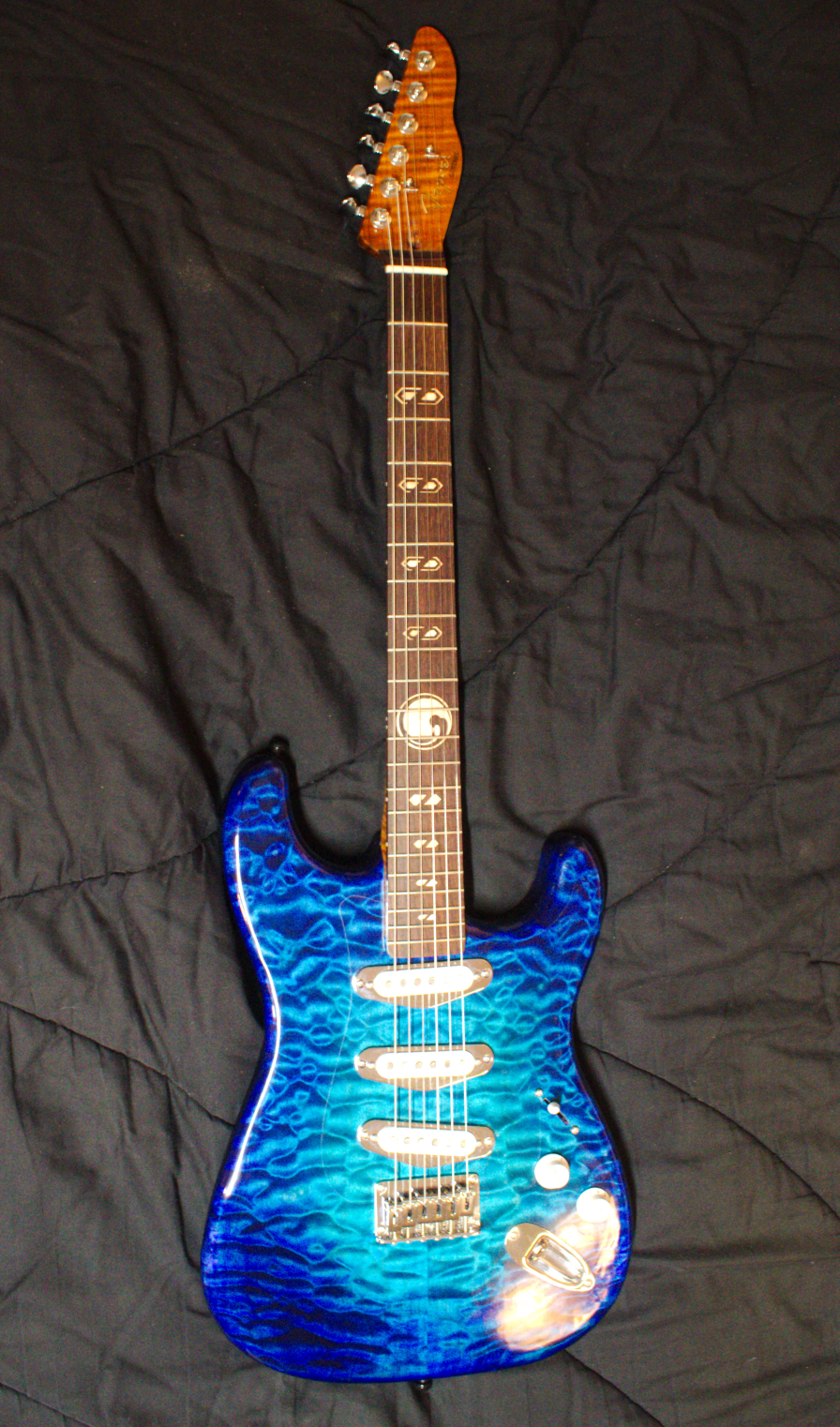
Following that another friend wanted me to make him a custom Strat. Based on a 1990 Strat. Quilted maple top. Possibly the most beautiful guitar I've ever built.
×
![]()
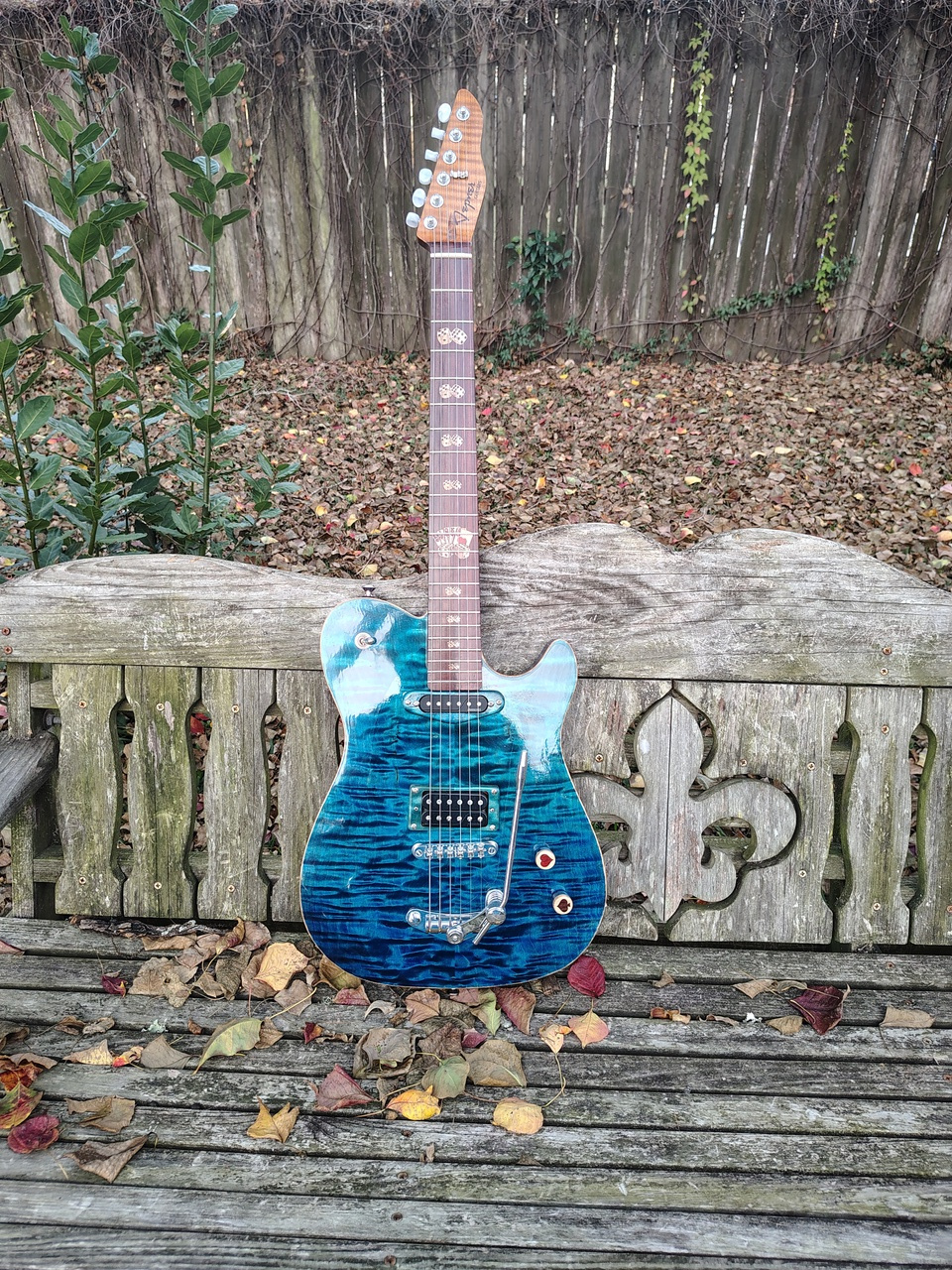
Back to themed guitars. Since my band plays at a number of casinos I thought maybe a casino themed guitar would be cool. Once again I thought that maybe a whammy bar would be fun so I built this one with an angled back neck. The inlays in the neck are just that - inlays, not stickers. The 12th fret inlay has about 30 different pieces of wood in it (I would hate to try to make that without a laser).
×
![]()
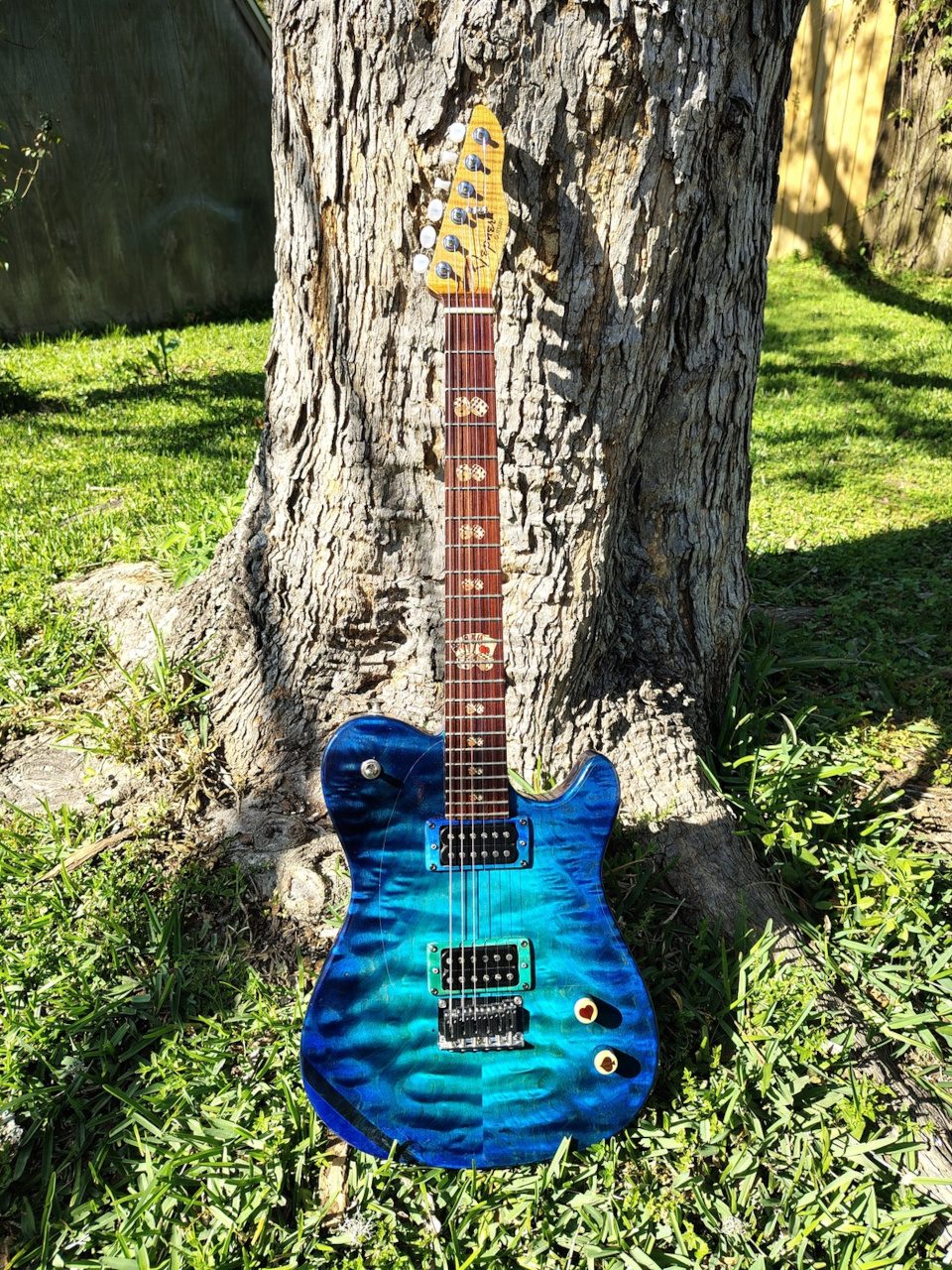
And, for the umpteenth time, I found I don't like whammy bars. I also discovered that I don't like neck angle. I gets the strings too far away from the body and just feels weird to me, YMMV. I'm also not as fond of faux binding as I though I was. It looks cool but it makes the edges uncomfortable. So, I replaced the body. Quilted maple, walnut, and basswood.
×
![]()
Much better.
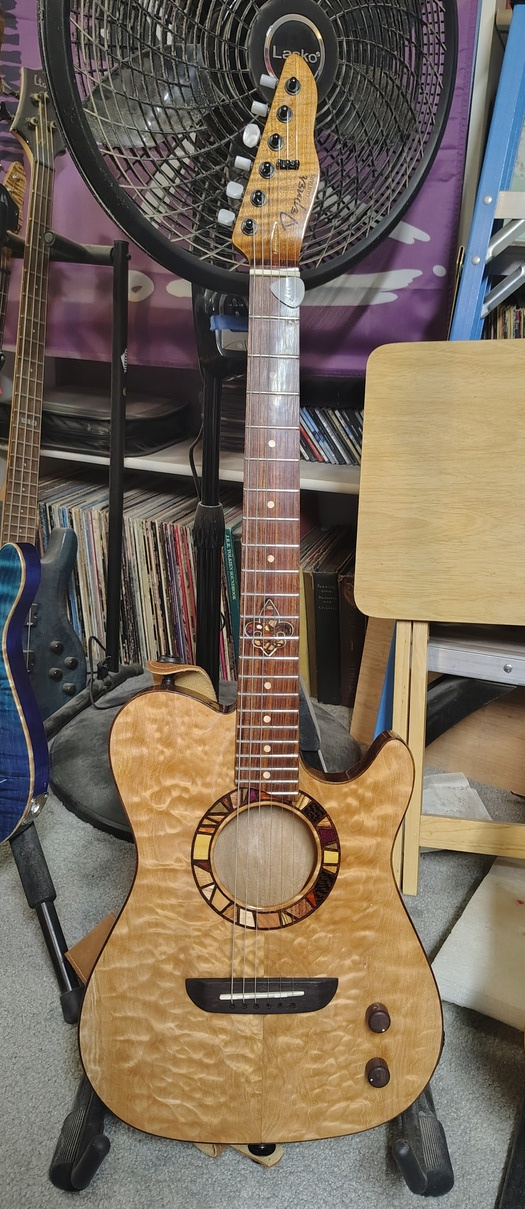
So, in 2026, my band was having bass player problems (like you do) and I thought I might be going back to an acoustic three piece. Because of my arthritis I use 24" scale conversion necks (see Building a neck in the menu at left). I have a lovely Carvin AC275 but it has a 25" scale neck and, in addition, it's kind of heavy. It plays great and sounds great but I needed a lighter, short scale guitar. Sooooo, I built one. I used an LR Baggs Element VTC and replaced the soundhole volume and tone controls with "normal" ones.
×
![]()
We got a new bass player so this one is just going to have to wait.
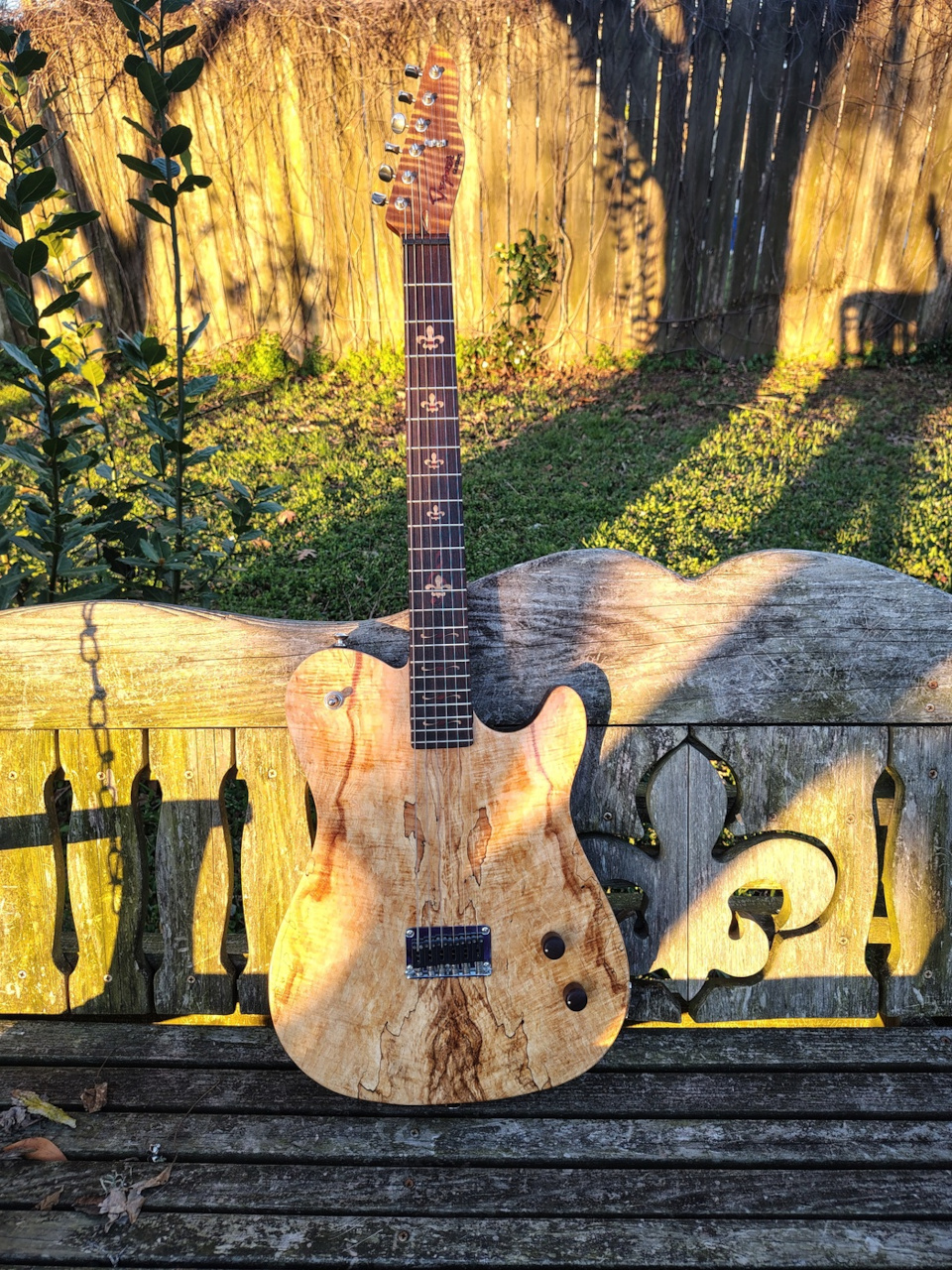
Following that, I had always wondered about the possibility of building a stealth guitar. A normal electric guitar but with the pickups hidden under the drop top. Why not build one.
×
![]()
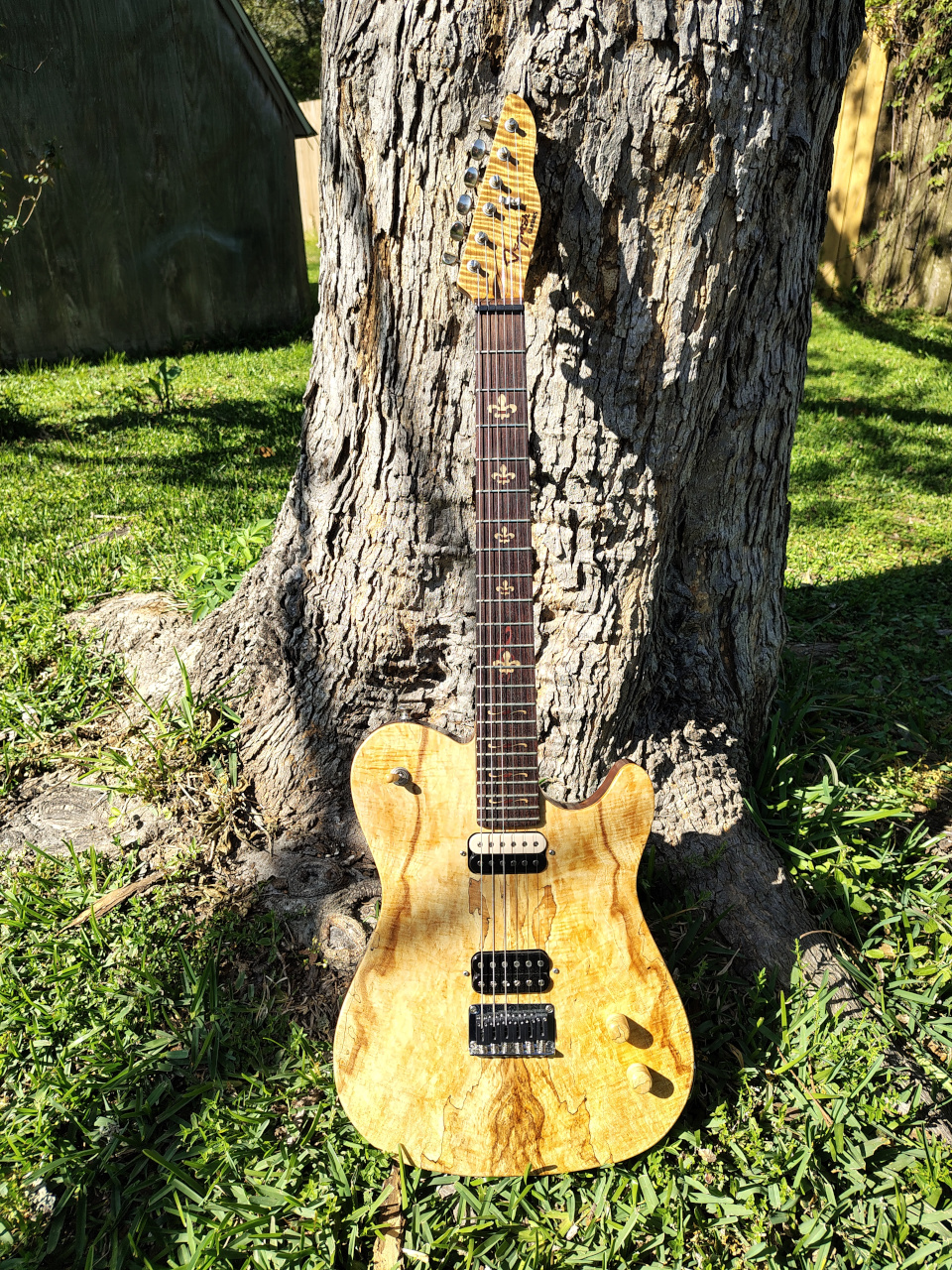
To get the pickups close enough to the strings I recessed the bridge, lowered the neck pocket, and recessed the underside of the drop top where the pickups reside. In addition I used Fishman Fluence Open Core Classic active humbuckers to be able to have enough power. It worked fine but it just didn't have a sound that I could use in a variety band (especially when playing rock). It would be ideal for a jazz band. So, I went with door number two and brought the pickups up through the top.
×
![]()
Plays and sounds great. I even found that I like the lower neck and bridge.
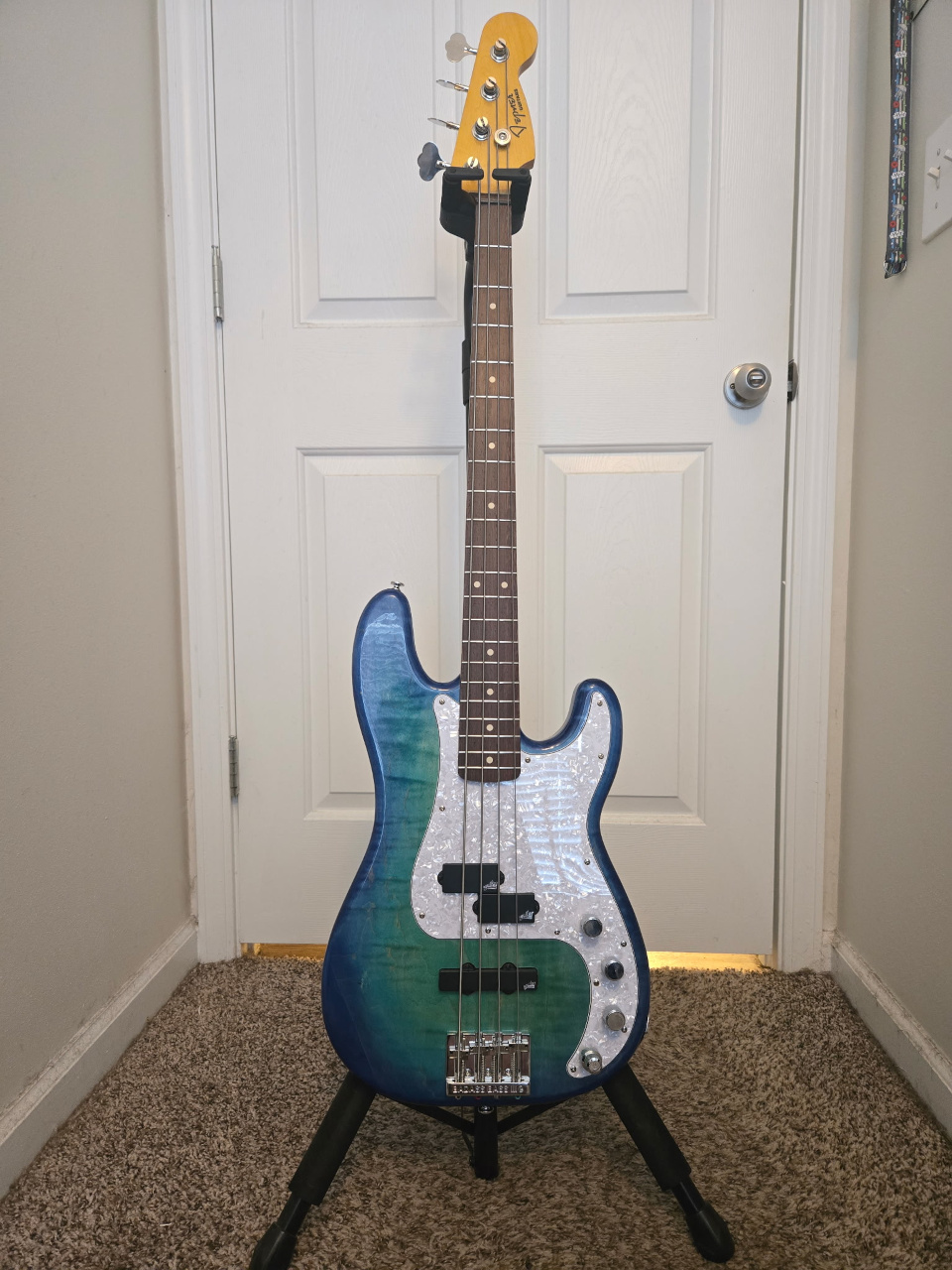
Right after completing that guitar a friend of mine wanted me to make him a five string bass. Specifically, a Precision style body, a Jazz style neck, and PJ pickups. He ordered the Jazz bass neck from Warmoth (with SS frets). I added Luminlay side dots and put my name on the headstock (he made me do it). The cool thing about this bass is that he sprung for Aguilar pickups and an Aguilar preamp (about $500 just for those). Also, a Leo Quan Badass III bridge. It sustains for about a week. The body is basswood (what else) and the top is lightly flamed 1/4" maple from Ocooch Hardwoods.
×
![]()
At that time I started playing around with some pickups. One of my favorite pickup sounds is the Strat neck single coil. Unfortunately they buzz like a hive of pissed off bees. I had been trying everything I could to get that sound. The Fishman Fluence Open Core Classics can get close when you switch to single coil mode but they still buzz a bit. I stumbled upon the Tonerider pickups somewhere (I don't remember exactly where) and I figured I'd give them a try. So, I bought the Tonerider Apex Classic neck pickup and put it in the Southwest guitar. Bingo! Perfect Strat neck pickup sound with absolutely no hum. Then I started wondering about why someone would use the Strat middle pickup and I found a number of sites online talking about just that. It appears that Pride and Joy, Sultans of Swing, and Heaven (Los Lonely Boys) were all done on the middle pickup. So, I bought a Tonerider Apex Classic middle pickup and retrofit it into the Southwest guitar. Yahtzee! Another incredible sound. I bought the Tonerider Apex Plus bridge pickup and tried it out but, just like almost any other bridge single coil, it was weak and thin. So, I put a Seymour Duncan Hot Rails into the bridge. I really liked the sound but I began to wonder what a guitar with the two Toneriders and a real humbucker in the bridge would sound like. Well, if you wonder about that you need to build a new guitar, right?
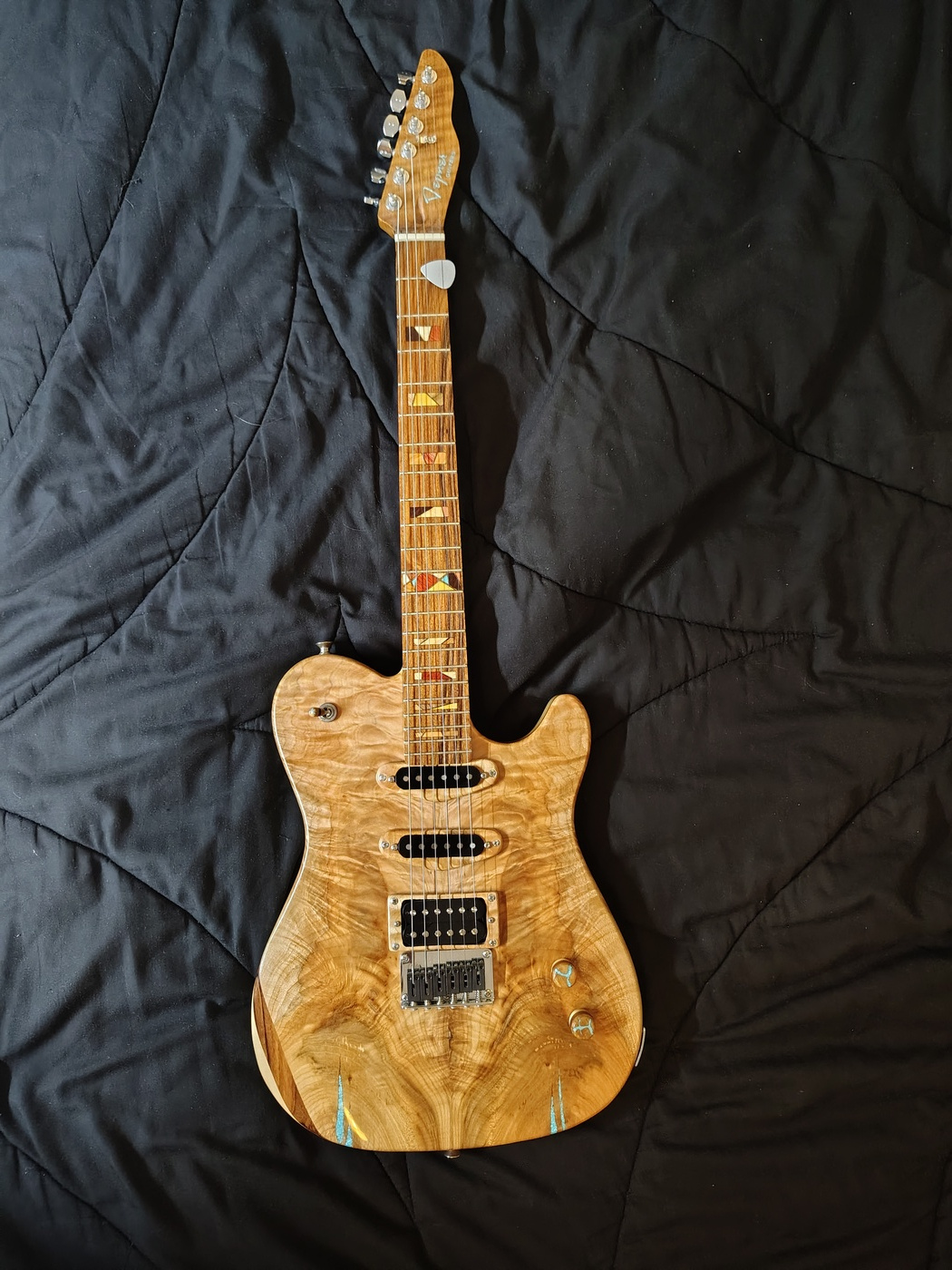
This is the guitar that Building a body and Building a neck (in the menu at left) cover. I found the coolest drop top at Oregon Wild Wood. Those guys have a lot of re-purposed and salvaged hardwoods for very good prices. The top had some gaps and I thought it might be cool to fill them with crushed turquoise. When I first built the guitar I tried a Seymour Duncan Stag Mag (SH-3) in the bridge position and it was pretty good but it's not a real humbucker. It's two Strat style single coils wired together with one RWRP. I then replaced it with a bridge humbucker out of a Yamaha SE350. It sounded better but what I really wanted was more of a PAF style humbucker. To that end I purchased a Tonerider AC2 Alnico II Classic Bridge Humbucker. Checkmate! That did it. The sounds I wanted. Check out the Wiring tab on the left to see how I wired it.
×
![]()
That's it up to now - October 11th, 2026.